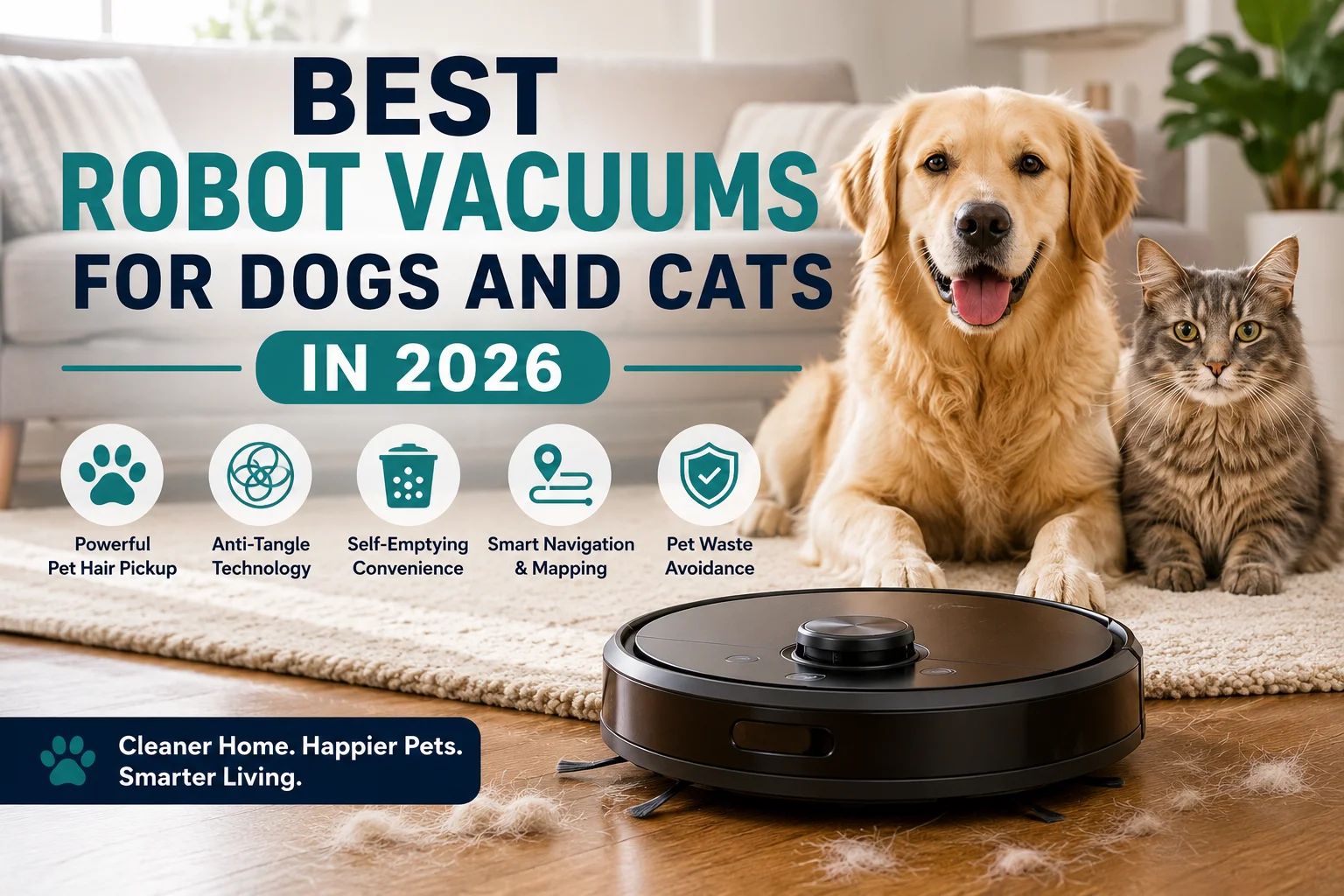
Best Robot Vacuums for Dogs and Cats in 2026
Written by: [F.A.J]
Last updated: August 29, 2026
If you live with a shedding dog or cat, you know how quickly pet hair can cover carpets, hardwood floors, rugs, and furniture. Finding the Best Robot Vacuums for Dogs and Cats in 2026 can make everyday cleaning easier by automatically collecting loose fur, dust, and debris while you spend more time with your pets and less time vacuuming.
However, not every robot vacuum is equally effective at handling pet hair. The right model depends on your pet’s shedding level, hair length, flooring type, home size, budget, and how much maintenance you are willing to handle.
In this guide, we compare the best robot vacuums for dogs and cats in 2026, explain the most important pet-hair features, and help you choose the right model for your home.
In this guide, we explain the most important features to look for in the best robot vacuum for pet hair, compare popular options, and show you how to choose the right robot vacuum for your dog or cat.
What Is the Best Vacuum for Pet Hair?
There is no single robot vacuum that is perfect for every pet household.
For most pet owners, look for a combination of strong pet-hair pickup, an anti-tangle brush system, reliable navigation, obstacle avoidance, good filtration, and a self-emptying dock.
Here is how to match the features to your needs:
| Pet owner’s needs | Features to prioritize |
|---|---|
| Heavy-shedding dog | Strong pickup, anti-tangle brush, self-emptying |
| Long-haired cat or dog | Anti-tangle brush and easy brush maintenance |
| Mostly carpet | Strong carpet cleaning and brush agitation |
| Mostly hardwood | Edge cleaning and fine-particle pickup |
| Multiple pets | Large dust capacity and self-emptying |
| Pet allergies | Effective filtration and regular cleaning |
| Pets that have accidents | Advanced obstacle and pet-waste avoidance |
| Large home | Good navigation, battery life, and recharge-and-resume |
The best robot vacuum is therefore the one that matches your pet, floor type, home, and cleaning routine.
Quick Comparison: Top Robot Vacuums for Pet Owners
The models below represent different types of robot vacuum buyers. Features and prices can change, so verify the current specifications before purchasing.
| Model | Best for | Key pet-hair feature | Navigation/avoidance | Self-emptying |
|---|---|---|---|---|
| Roborock S8 MaxV Ultra | Premium all-around cleaning | Dual brush system and strong suction | Advanced obstacle recognition | Yes |
| iRobot Roomba Combo j9+ | Pet-focused obstacle avoidance | Dual rubber brush system | PrecisionVision obstacle recognition | Yes |
| Dreame L20 Ultra | Large mixed-floor homes | Strong pickup and automated dock | AI-assisted navigation | Yes |
| Ecovacs DEEBOT X2 Omni | Low-profile cleaning | Strong suction and brush system | Advanced 3D obstacle avoidance | Yes |
| Shark Matrix Plus 2-in-1 | Value-focused shoppers | Self-cleaning brushroll | LiDAR-based navigation | Yes |
Important: Specifications, accessories, prices, and availability can change. Always check the manufacturer’s current product information before buying.
What Makes a Robot Vacuum Good for Pet Hair?
A robot vacuum designed for pet hair should do more than advertise high suction power.
The most important features include:
- Pet-hair pickup
- Anti-tangle brush design
- Carpet cleaning performance
- Hard-floor cleaning
- Obstacle avoidance
- Self-emptying
- Effective filtration
- Easy maintenance
A combination of these features is generally more useful than focusing on one specification.
Strong Suction and Pet-Hair Pickup
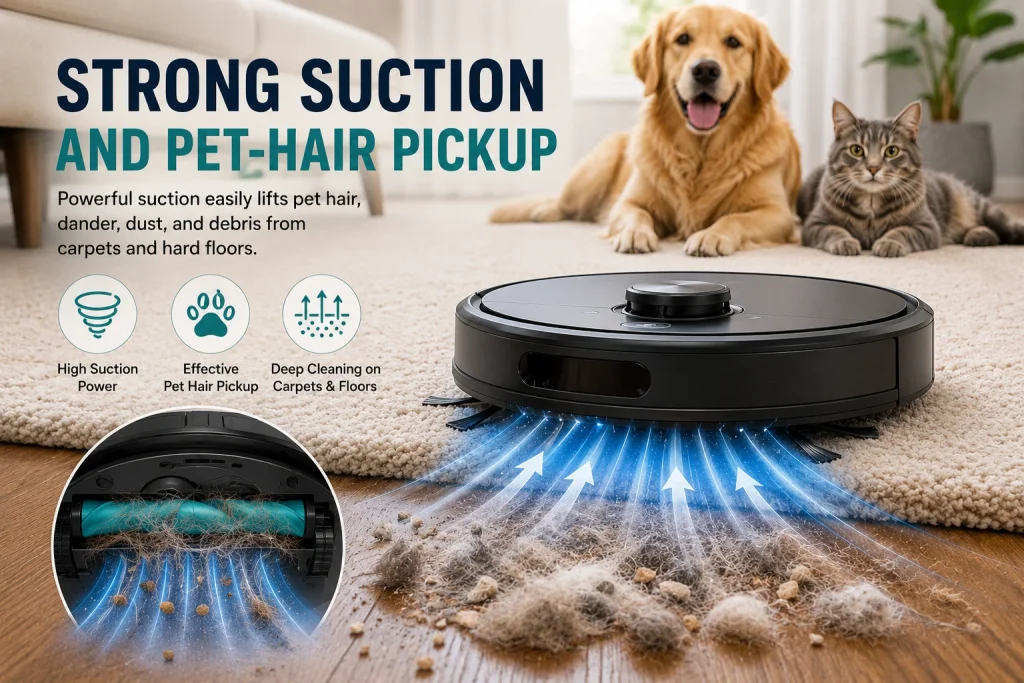
Pet hair can sit loosely on hardwood or become embedded in carpet fibers. Strong suction can help remove hair and debris, but suction power alone does not determine cleaning performance.
Brush design, airflow, floor type, navigation, and cleaning passes also matter.
Therefore, instead of choosing a robot based only on its Pascal rating, consider independent cleaning tests and the robot’s overall design.
Anti-Tangle Brush Technology
Long dog and cat hair can wrap around a robot vacuum’s main brush.
Over time, tangled hair can reduce cleaning performance and increase maintenance.
For long-haired pets, look for:
- Rubber brush rollers
- Anti-tangle designs
- Easy-to-remove brushes
- Hair-detangling features
- Accessible brush bearings
Even advanced anti-tangle systems may require occasional cleaning, especially in homes with heavy shedding.
Obstacle Avoidance and Pet-Waste Detection
Pet owners often leave toys, bowls, cables, and other objects on the floor.
An advanced obstacle-recognition system can help the robot identify and avoid some of these objects.
This is especially important when pets are involved because accidentally running over pet waste can create a much bigger cleaning problem.
Some premium models use cameras, structured-light sensors, LiDAR, or other technologies to identify obstacles.
However, no robot vacuum should be assumed to detect every pet accident perfectly.
For safety, inspect the floor before starting a cleaning cycle whenever possible.
Self-Emptying Dock
Pet hair takes up considerable space in a robot’s dustbin.
A self-emptying dock allows the robot to return to its base and transfer collected debris into a larger container or dust bag.
This can be especially useful if you have:
- Multiple pets
- Heavy-shedding dogs
- Long-haired cats
- A large home
- Daily cleaning schedules
Self-emptying does not mean maintenance-free. Filters, brushes, sensors, and other components still require regular attention.
Filtration for Pet Hair and Dander
Pet hair is visible, but pets can also contribute dander and fine dust to the home.
If filtration is important to you, look for a robot with an effective high-efficiency filter and a well-designed dust-management system.
Remember that filtration claims should be checked against the manufacturer’s specifications. A robot vacuum should not be treated as a complete solution for allergies.
Detailed Reviews of Popular Robot Vacuums for Pet Hair
Roborock S8 MaxV Ultra — Best Premium All-Around Option
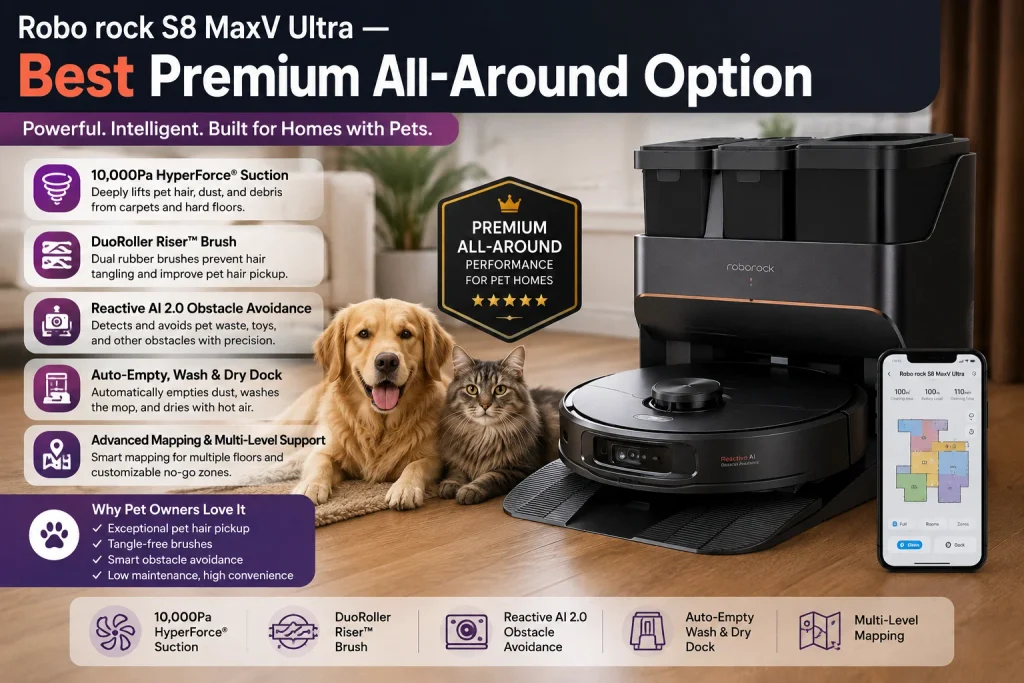
The Roborock S8 MaxV Ultra is a premium robot vacuum and mop designed for homes that want extensive automation.
Its pet-friendly features include strong suction, a dual-brush cleaning system, advanced obstacle recognition, and an automated dock.
It is particularly attractive to pet owners who want a machine that can handle regular vacuuming while also providing automated mop and dock functions.
Best for: Pet owners who want premium automation.
Consider it if you need: Strong cleaning, advanced navigation, and extensive dock automation.
Potential drawback: Premium robot vacuums can be expensive, and replacement consumables should be included in your ownership budget.
iRobot Roomba Combo j9+ — Best for Pet-Focused Obstacle Avoidance
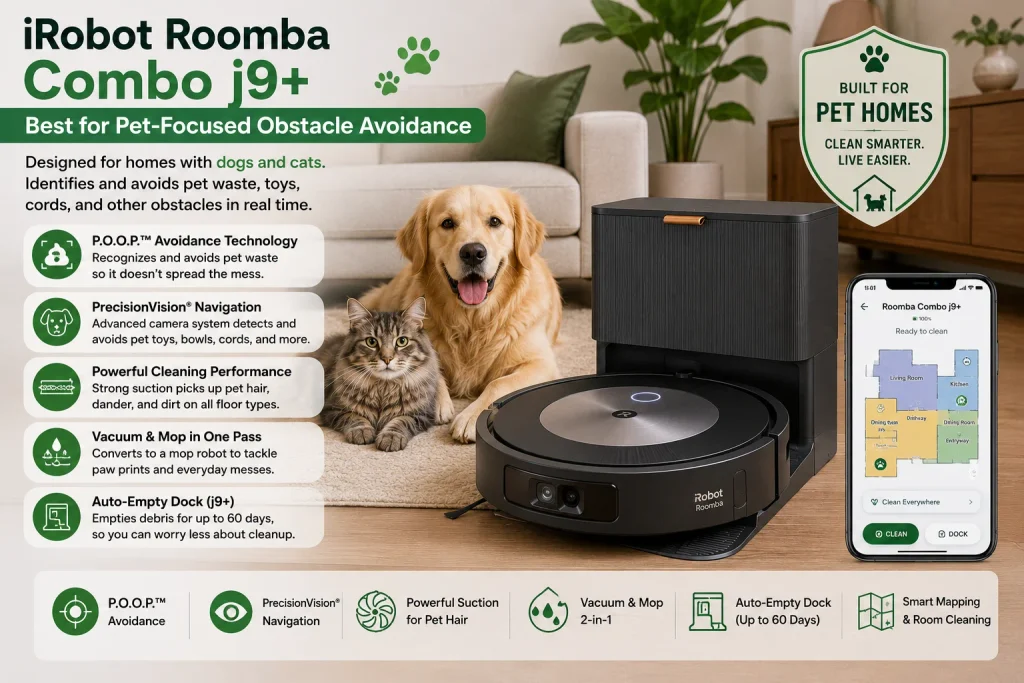
The iRobot Roomba Combo j9+ is designed for homes where obstacle recognition is particularly important.
Its PrecisionVision navigation system is designed to recognize and avoid certain objects, including common household obstacles. iRobot has also promoted its P.O.O.P. guarantee for eligible customers, focused on avoiding solid pet waste.
The robot also uses dual rubber brush rollers, which are useful for collecting hair while reducing the need for traditional bristle-brush maintenance.
Best for: Pet owners who place a high priority on obstacle avoidance.
Consider it if you need: Pet-focused object recognition and an automated cleaning system.
Potential drawback: Advanced features and a premium dock can increase the purchase price.
Dreame L20 Ultra — Best for Automated Mixed-Floor Cleaning
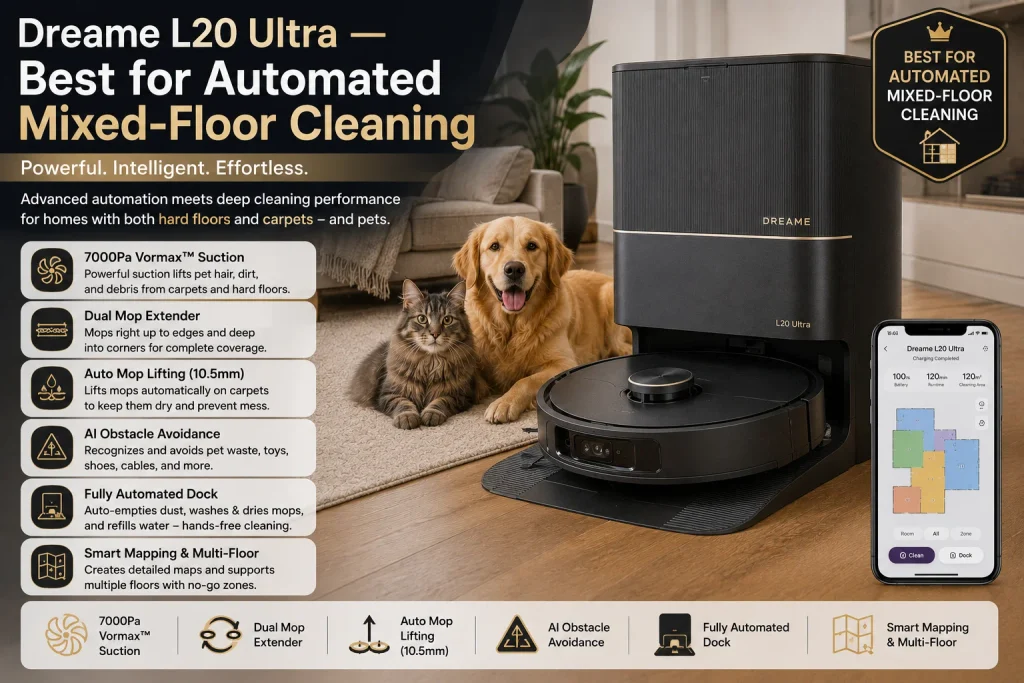
The Dreame L20 Ultra combines vacuuming and mopping with an automated base station.
Its design is suited to homes with a mixture of hard flooring and rugs, while its automated dock can reduce daily maintenance.
For pet owners, the combination of automated vacuuming, mopping, and dock functions can be useful when pets frequently bring dirt indoors.
Best for: Large homes and mixed-floor households.
Consider it if you need: Automated vacuuming and mopping.
Potential drawback: More complicated dock systems can require more cleaning and maintenance.
Ecovacs DEEBOT X2 Omni — Best for Low-Profile Access
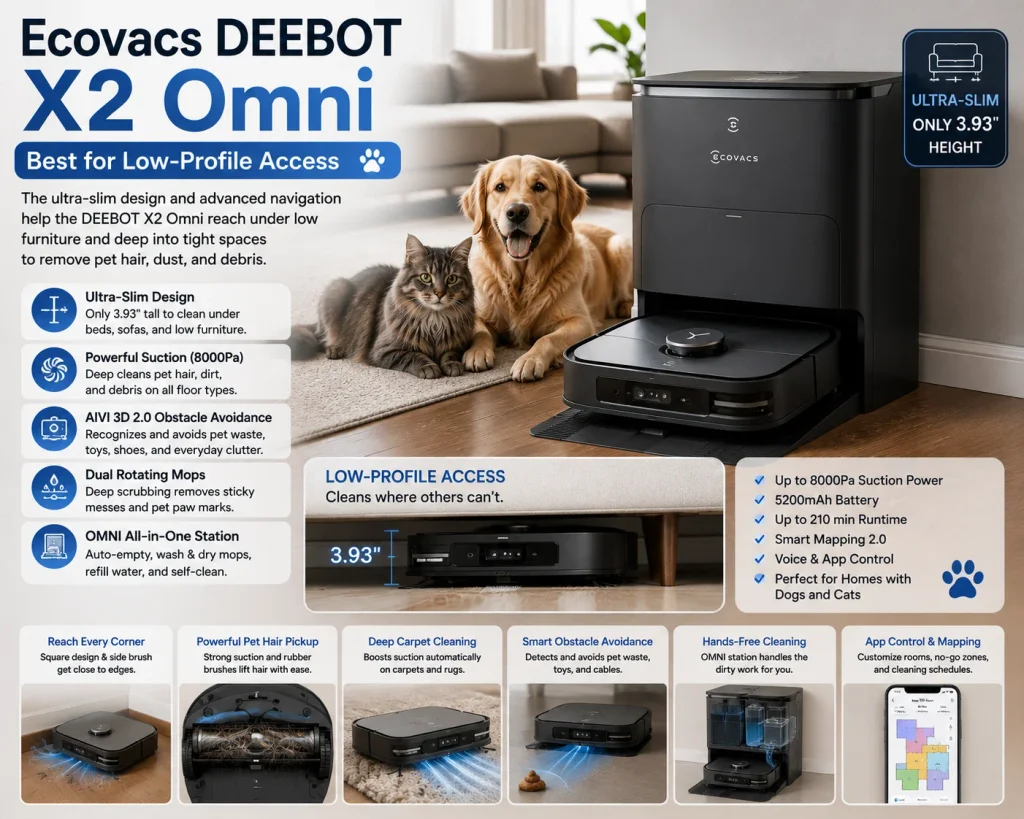
The Ecovacs DEEBOT X2 Omni uses a low-profile design compared with many traditional robot vacuum shapes.
This can be useful if pet hair frequently collects underneath furniture.
Its combination of vacuuming, mopping, navigation, and automated dock functions makes it another option for pet households.
Best for: Homes with furniture where low-profile cleaning is important.
Potential drawback: Check the robot’s current dimensions against the clearance underneath your furniture before purchasing.
Shark Matrix Plus 2-in-1 — Best Value-Oriented Option
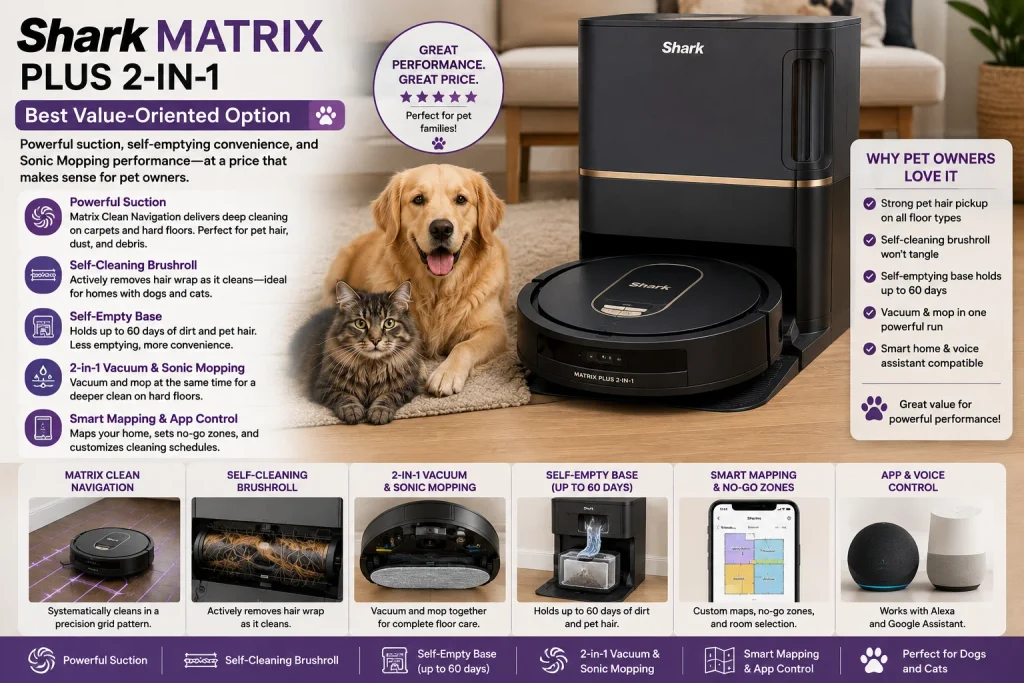
The Shark Matrix Plus 2-in-1 combines vacuuming and mopping with a self-cleaning brushroll and automated cleaning features.
Its Matrix cleaning approach is designed to make repeated cleaning passes over areas of debris.
Best for: Pet owners looking for a combination of vacuuming, mopping, and automated cleaning without moving directly into the highest-priced category.
Potential drawback: Compare its current cleaning performance and maintenance costs with competing models before making a final decision.
Best Robot Vacuum for Long Pet Hair
If your dog or cat has long hair, the brush system should be one of your biggest priorities.
Long hair can wrap around the roller and side brushes.
Look for:
- Anti-tangle technology
- Rubber rollers
- Easy brush removal
- Accessible brush bearings
- Automatic detangling where available
- Strong pet-hair pickup
Long Hair vs. Short Hair
Short pet hair can be easier for some robots to collect, but fine hair and dander can still require effective filtration and airflow.
Long hair creates a different challenge because it can physically wrap around moving parts.
Therefore, anti-tangle performance becomes more important as hair length and shedding increase.
Best Robot Vacuum for Dog Hair
Dogs can produce significant amounts of hair, dirt, and outdoor debris.
If your dog sheds heavily, consider:
- Strong carpet cleaning
- Effective brush agitation
- Anti-tangle technology
- Self-emptying
- Large dust capacity
- Frequent scheduling
- Good obstacle avoidance
For a single low-shedding dog, you may not need every premium feature.
For multiple heavy-shedding dogs, however, automation can make a much bigger difference.
Best Robot Vacuum for Cat Hair
Cat hair often collects around:
- Baseboards
- Cat beds
- Scratching posts
- Furniture
- Litter boxes
- Food areas
For cat owners, prioritize:
- Hard-floor pickup
- Edge cleaning
- Low-profile access
- Filtration
- Anti-tangle brush design
- Reliable navigation
A robot that can travel underneath furniture can be especially helpful because cats often leave hair in difficult-to-reach areas.
Best Pet Hair Robot Vacuum for Carpet and
Carpets can hold pet hair more tightly than smooth floors.
For carpeted homes, look for:
- Strong brush agitation
- Good suction
- Carpet detection
- Automatic suction adjustment
- Effective deep-cleaning performance
Do not judge a robot only by its hardwood-floor performance.
A model can perform well on hard floors but produce different results on thick or medium-pile carpet.
Best Vacuum Robot for Hardwood Floors
Hardwood floors typically make loose pet hair easier to collect, but hair can still accumulate around edges and furniture.
Look for:
- Strong edge cleaning
- Fine-debris pickup
- Effective side brushes
- Reliable navigation
- Gentle floor-cleaning settings
If you also have rugs, choose a robot that can recognize different surfaces and adjust its cleaning behavior.
Best Robot Vacuum for Multiple Pets
Multiple pets usually mean more hair and more frequent cleaning.
For a multi-pet household, self-emptying can become particularly valuable.
Prioritize:
- Large dust capacity
- Self-emptying
- Anti-tangle brushes
- Strong cleaning performance
- Multi-room mapping
- Long battery life
- Recharge-and-resume cleaning
A daily cleaning schedule can help prevent pet hair from accumulating before it becomes difficult to remove.
Best Robot Vacuum for Pet Waste Avoidance
This feature deserves special attention.
A robot vacuum that accidentally drives through pet waste can spread the mess across the floor and potentially into its brush system.
Advanced obstacle-recognition systems may identify certain objects and waste.
However, detection performance varies by model and environment.
Therefore:
Never rely entirely on a robot vacuum to detect pet waste.
Before scheduled cleaning, remove known hazards from the floor whenever possible.
Self-Emptying vs. Standard Robot Vacuum
Standard dustbin
The robot collects debris in a small onboard container that you empty manually.
Self-emptying dock
The robot returns to its base and transfers debris into a larger container or bag.
For pet owners, self-emptying is particularly useful when:
- Your pet sheds heavily
- You have multiple pets
- You run the robot every day
- You have a large home
- You want less daily maintenance
The trade-off is that self-emptying docks can add cost and may require replacement bags or additional maintenance.
Vacuum-Only vs. Vacuum-and-Mop
A vacuum-and-mop robot can be useful for homes where pets track dirt onto hard floors.
Choose a vacuum-focused model if:
- Pet hair is your main problem.
- Your home contains lots of carpet.
- You already own a separate mop.
- You want to prioritize vacuum performance.
Consider a vacuum-and-mop model if:
- You have mostly hard floors.
- Your pets frequently bring dirt indoors.
- You want automated mopping.
- You regularly deal with muddy paw prints.
A mop function does not replace effective vacuuming for pet hair.
How Much Does a Robot Vacuum Cost to Maintain?
The purchase price is only part of the cost.
You may also need:
- Filters
- Main brushes
- Side brushes
- Dust bags
- Mop pads
- Cleaning solution
- Replacement parts
Your estimated ownership cost can therefore be thought of as:
Purchase price + replacement parts + consumables = total ownership cost
Before buying, check whether replacement parts are readily available and how much they cost.
How We Evaluate Robot Vacuum
A pet-focused comparison should consider more than manufacturer specifications.
Our recommended evaluation framework is:
| Category | Weight |
|---|---|
| Pet-hair pickup | 25% |
| Anti-tangle performance | 20% |
| Carpet cleaning | 15% |
| Hard-floor cleaning | 10% |
| Obstacle avoidance | 10% |
| Self-emptying | 10% |
| Filtration | 5% |
| Maintenance and value | 5% |
| Total | 100% |
We recommend comparing independent testing, manufacturer specifications, warranty information, current pricing, and real-world ownership considerations.
Editorial note: We do not treat manufacturer advertising claims as independent test results. When a performance number comes from a manufacturer or third-party testing organization, identify the source clearly.
Robot Vacuums Pet Buying Checklist
🐾 Robot Vacuum Pet Buying Checklist
Check the features that matter for your pet and get your personalized robot vacuum score.
Common Mistakes When Buying a Robot Vacuum for Pet Hair
Mistake 1: Choosing only by suction power
A higher advertised Pa number does not automatically guarantee better pet-hair cleaning.
Brush design, airflow, navigation, floor type, and cleaning passes also matter.
Mistake 2: Ignoring hair tangles
Long pet hair can wrap around brushes and increase maintenance.
Mistake 3: Forgetting your flooring
A robot that works well on hardwood may not provide the same results on thick carpet.
Mistake 4: Ignoring replacement costs
Check filters, brushes, bags, mop pads, and other consumables before purchasing.
Mistake 5: Assuming obstacle avoidance is perfect
Advanced sensors can help, but you should still remove dangerous objects and pet waste whenever possible.
FAQs
What Is the Best Robot Vacuum for Long Pet Hair?
The best robot vacuum for long pet hair is one with strong pet-hair pickup, an effective anti-tangle brush system, and a self-emptying dock. Long dog and cat hair can wrap around brush rollers and side brushes, so brush design is especially important.
When shopping for a robot vacuum for long-haired pets, look for:
- Anti-tangle or hair-detangling technology
- Rubber or redesigned brush rollers
- Strong suction and airflow
- Easy-to-remove brush rolls
- Large dust capacity
- Self-emptying capability
No robot vacuum is completely maintenance-free. Even models with advanced anti-tangle systems should be checked regularly for hair around the brushes, wheels, and bearings.
Best for: Long-haired dogs, cats, and heavy shedders.
What Is the Best Robot Vacuum for Heavy-Shedding Dogs?
For heavy-shedding dogs, the best robot vacuum is one that combines strong hair pickup, anti-tangle brushes, good carpet cleaning, and a self-emptying dock.
Heavy-shedding dogs can produce large amounts of fur every day. A small robot dustbin can fill quickly, forcing you to empty it frequently. A self-emptying dock makes daily cleaning much more convenient.
Prioritize:
- Strong carpet cleaning
- Anti-tangle brush technology
- Large dust capacity
- Self-emptying
- Frequent scheduling
- Reliable navigation
- Easy filter and brush maintenance
For homes with multiple heavy-shedding dogs, running the robot frequently can help prevent hair from accumulating and becoming embedded in carpet.
Best for: Labrador Retrievers, Golden Retrievers, German Shepherds, Huskies, and other heavy-shedding dogs.
What Is the Best Robot Vacuum for Cat Hair and Litter?
The best robot vacuum for cat hair and litter should handle fine hair, small debris, and scattered litter while reaching edges and areas around furniture.
Cat hair often collects along baseboards, under furniture, around scratching posts, and near sleeping areas. Cat litter can also scatter several feet from the litter box.
Look for:
- Strong hard-floor pickup
- Effective edge cleaning
- Anti-tangle brushes
- Good filtration
- Reliable navigation
- Low-profile design
- Easy brush and filter maintenance
A robot vacuum can help collect loose litter and hair around the litter-box area, but it should not be expected to clean wet litter or large messes.
Best for: Cat owners with hardwood, tile, laminate, or mixed flooring.
What Is the Best Robot Vacuum for Multiple Pets?
The best robot vacuum for multiple pets should focus on automation, dust capacity, hair management, and reliable navigation.
Two or three pets can produce considerably more hair and debris than one pet. Therefore, a self-emptying dock becomes especially useful.
For a multi-pet home, prioritize:
- Self-emptying
- Anti-tangle brushes
- Large dust capacity
- Strong pet-hair pickup
- Multi-room mapping
- Recharge-and-resume cleaning
- Good obstacle avoidance
- Easy maintenance
If your pets shed heavily, scheduling the robot to clean frequently can help keep hair under control.
Best for: Homes with two or more dogs, cats, or mixed pets.
What Robot Vacuum Does Not Get Pet Hair Tangled?
There is no robot vacuum that should be considered completely tangle-proof. However, some models are specifically designed to reduce hair wrapping with rubber rollers, dual-brush systems, anti-tangle designs, or automatic hair-detangling technology.
For long-haired pets, compare the robot’s:
- Main brush design
- Side-brush design
- Anti-tangle technology
- Hair-detangling system
- Brush-bearing accessibility
- Ease of removing wrapped hair
A robot that is easy to maintain can be more practical than one that has impressive specifications but requires difficult brush cleaning.
Best approach: Choose anti-tangle technology first if your pet has long hair or sheds heavily.
Can a Robot Vacuum Detect and Avoid Pet Poop?
Some advanced robot vacuums can detect and avoid pet waste, but you should never assume that any robot will identify every accident.
Premium models may use cameras, 3D sensors, artificial intelligence, or other object-recognition technologies to identify obstacles. Some systems are specifically marketed for recognizing pet waste.
This feature can be particularly useful for homes with:
- Puppies
- Kittens
- Senior pets
- Pets that occasionally have accidents
However, detection can depend on lighting, object size, floor conditions, camera visibility, and the robot’s software.
If there is known pet waste on the floor, remove it before starting the robot.
Important: Pet-waste avoidance is an additional safety feature, not a guarantee that the robot will never run over an accident.
Can a Robot Vacuum Remove Embedded Pet Hair From Carpet?
Yes, a robot vacuum can remove some embedded pet hair from carpet, but performance depends on the carpet, hair type, brush design, suction, and cleaning pattern.
Loose hair is generally easier to collect than hair that has become deeply embedded in dense carpet fibers.
For carpet-heavy homes, look for:
- Strong carpet cleaning performance
- Effective brush agitation
- Automatic carpet boost
- Strong airflow
- Multiple cleaning passes
- Good anti-tangle performance
Regular cleaning is also important. Running the robot frequently can prevent hair from accumulating and becoming increasingly difficult to remove.
For deeply embedded hair, a powerful upright or cordless vacuum may still be necessary for occasional deep cleaning.
Best approach: Use the robot for frequent maintenance and a conventional vacuum for deeper cleaning.
How Often Should You Run a Robot Vacuum With Pets?
For many homes with shedding pets, running a robot vacuum once a day is a good starting point. Heavy-shedding or multi-pet households may benefit from even more frequent cleaning if the robot and flooring allow it.
Your ideal schedule depends on:
- Number of pets
- Shedding level
- Hair length
- Flooring
- Home size
- Season
- Outdoor activity
For example, a home with one low-shedding cat may need less frequent cleaning than a home with two heavy-shedding dogs.
If your robot is collecting large amounts of hair every day, check the brushes, filter, wheels, and dust system regularly.
Simple rule: More shedding usually means more frequent cleaning.
Can a Robot Vacuum Replace a Regular Vacuum for Pet Hair?
A robot vacuum can significantly reduce everyday pet hair, but it should not completely replace a regular vacuum for most pet owners.
Robot vacuums are excellent for routine floor maintenance because they can clean automatically on a schedule. However, they cannot always reach:
- Stairs
- Sofas
- Chairs
- Curtains
- Upholstery
- Tight corners
- High surfaces
- Some areas underneath furniture
A regular upright, canister, or cordless vacuum can provide deeper cleaning and reach areas a robot cannot.
The most practical setup for many pet households is:
Robot vacuum = frequent everyday cleaning
Regular vacuum = deep cleaning and hard-to-reach areas
Together, they can provide better overall pet-hair control than relying on either one alone.
How Much Does a Robot Vacuum Cost to Maintain With Pets?
The cost of maintaining a robot vacuum depends on the model, how frequently you use it, how many pets you have, and how much they shed.
Common replacement and maintenance items include:
- Main brushes
- Side brushes
- Filters
- Dust bags
- Mop pads
- Cleaning solution
- Replacement wheels or other components
Heavy-shedding pets may require more frequent brush and filter cleaning than low-shedding pets.
When comparing models, don’t look only at the purchase price. Consider the total cost of ownership:
Robot price + replacement parts + consumables = ownership cost
A self-emptying robot can reduce daily maintenance, but it may require replacement dust bags or other dock consumables.
Before buying, check the manufacturer’s recommended replacement schedule and the current prices of compatible parts.
Best approach: Choose a robot that fits both your initial budget and your expected long-term maintenance budget.
Final Verdict: What Is the Best Robot Vacuum for Pet Hair?
The best robot vacuum for pet hair is not necessarily the most expensive model or the one with the highest advertised suction number.
Instead, choose a robot that matches your specific situation.
Choose a premium model such as the Roborock S8 MaxV Ultra if you want extensive automation and advanced cleaning features.
Most importantly, consider your pet’s shedding level, hair length, flooring, number of pets, furniture clearance, and maintenance needs before buying.
The right robot vacuum can reduce everyday pet hair and save cleaning time, but regular maintenance is still necessary for the best long-term performance.
Editor’s Recommendation
For pet owners, the most important features are not simply suction power or the number of smart features. Focus first on pet-hair pickup, anti-tangle performance, navigation, obstacle avoidance, self-emptying, filtration, and maintenance costs.
That approach will help you choose a robot vacuum that works for your actual home rather than simply choosing the model with the longest feature list.
About the Author
[F.A.J] is a pet-content writer at PetCoNearMe, creating practical guides to help pet owners make informed decisions about pets, pet care, household products, and pet-related costs.
Articles are researched using manufacturer information, reputable independent testing organizations, veterinary or animal-welfare resources when appropriate, and other authoritative sources.
Editorial policy: Product recommendations are based on the features and information available at the time of publication. Product prices, specifications, availability, and software features may change.
Last updated: August 29, 2026