
Low-Maintenance Classroom Pets:15 Kid-Friendly Choices
Low‑maintenance classroom pets offer students hands‑on lessons about responsibility, animal behavior, science, empathy and caring for another living thing (Author F.A.J). However the best classroom pet is not simply the cheapest or easiest to buy. Teachers must also consider space, noise, handling, allergies, hygiene, school policies, veterinary care, weekends and long school breaks.
American Humane Society notes that classroom pets can support lessons, about responsibility, compassion, empathy and respect while giving students opportunities to participate in care routines.
In this guide we will examine 15 classroom‑pet options. Explain which options may work best for different ages, classroom environments and teacher workloads.
Important: According to the animal protection rules, the classes having pets must be maintained completely . this maintence must be specific according to the specific need of the pet. like water, food, protection etc, when schools are colosed.
Good Classroom Pet requirements?
Class room pets must be according to the need of the class room not for the specific individual or for personal requirements.
Here are some points, must follow these before selecting the Low-Maintenance Classroom Pets:
- Maintenance: find that how much the daily and weekly expenses of the specific pets.
- Noise: Noise producing pets are not good for class room.
- Space: pet can be manage in less space in side the class room.
- Handling: the animal can be handled easily by the students.
- Hygiene: hand washing practice must be after handling the pets.
- Allergies: Avoid those pets whose skin, fur or other material that cause allergic effects.
- Cost: What will the habitat, food, supplies, and veterinary care cost?
- School breaks: duty of a person that will care during holidays.
- Age suitability: Animal according to the age entrust of the students.
- School rules: Does your school permit this type of animal?
MOST important: The health concerns must be there in the school that will handle the situation in case of the allergic or any other accidents in the school related to the pets.
15 Best Low-Maintenance Classroom Pets
We can consider these 15 pets as “Low-maintenance”. its means we can mange the pets in reasonable amount and these are relatively manageable compared with other pets in side the class room.
1. Fish — Best for Quiet Observation
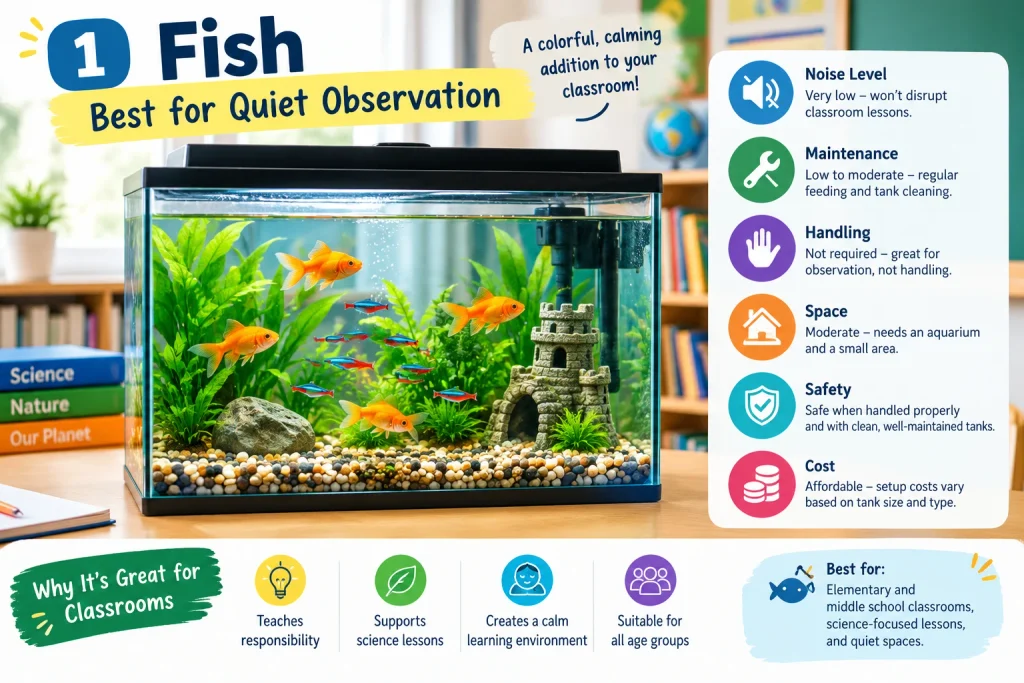
Fish are most popular choices for classrooms, because they are easy to observed without requiring students help.
A proper maintained aquarium can be useful as science resource. Students can find swimming activities, feeding, way of living, water quality, and biological cycles.
Best for: Eight grade classrooms, science lessons, silent classrooms
Maintenance: Low cost to maintain
Noise: almost nigligible
Handling: None
Some other important things to do: fish do not need only food and water, it requires lot of other indicators like. Water quality, filtration, temperature maintain appropriate, tank volume, and constent maintenance matter.
Fish were the most common classroom pet in a large American Humane survey of teachers, followed by guinea pigs, hamsters, bearded dragons, and leopard geckos.
2. Guinea Pigs — Best Interactive Small Mammal

Guinea pigs can be important classroom animals, Students can understand their behavior when appropriate, interact pigs under adult supervision.
They are social animals and require proper companionship, habitat, food, sleeping area, enrichment, and proper cleaning.
Low-Maintenance Classroom Pets: older students
Maintenance: Moderate
Noise: Low
Handling: Supervision necessary
Main consideration: They need considerably more space and proper care than their small size might suggest.
Guinea pigs should therefore be considered manageable rather than maintenance-free.
3. Leopard Gecko — Best Quiet Reptile

Leopard geckos are important with respect to under standing about the reptiles. Like there habitats, adaptation and feeding. important with respect to the academic lessons.
However, they can live in a correctly designed area, appropriate temperature and lighting apparatus, suitable feed, and proper handling.
Best for: Middle, and high school students
Maintenance: not to expensive
Noise: Very low
Handling: Under Supervision
Main consideration: Reptiles require more specialized husbandry than many beginners expect.
According to CDC the reptiles and amphibians are more likely than many other pets to carry germs such as Salmonella, even when they appear healthy.
4. Gerbils — Best for Active Observation

Gerbils are small, engaging animals that can encourage students to find burrowing, locomotion, feeding, and social behavior.
They need a secure enclosure, proper bedding, enrichment, feed, water, and regular removal of waste.
Best for: all students
Maintenance: Moderate
Noise: Low
Handling: under supervision
Main consideration: Their habitat should available opportunities for natural behaviors rather than being treated as a tiny cage.
5. Hamsters — Popular but Not Always Ideal
Hamsters are mostly remanded as easy classroom pets, because they are small and inexpensive for class room as compared with larger animals.
However, there is an main classroom issue: hamsters are mostly more active during the evening and night.
it’s means students can not see much activity during a specific school time.
Best for: Older elementary and middle school classrooms
Maintenance: Normal
Noise: Low
Handling: Supervised
Main consideration: No doubt learning is necessary. But, it is also important to follow the instruction related to the sleep or rest time of the animal, for his healthy life style.
6. Rats — Intelligent and Interactive
Domesticated rats can be highly interactive and provide excellent opportunities for observing animal intelligence, learning, social behavior, and problem-solving of Low-Maintenance Classroom Pets.
They need suitable housing, enrichment, nutrition, social companionship, and regular cleaning.
Best for: Older students with strong teacher supervision
Maintenance: Moderate
Noise: Low
Handling: Supervised
Main consideration: Rodents can create allergy and hygiene concerns, so classroom policies and individual student needs should be considered carefully.
7. African Dwarf Frogs — Interesting Aquatic Animals
African dwarf frogs can be fascinating additions to an appropriate aquarium and select as Low-Maintenance Classroom Pets.
They are mainly an observation pet rather than an animal students should routinely handle.
Best for: Science-focused classrooms
Maintenance: Moderate
Noise: Very low
Handling: Avoid routine handling
Main consideration: Aquarium maintenance and water quality are essential.
8. Snails — Simple Observation Pet
Snails can provide an interesting way to teach students about animal behavior, movement, feeding, habitats, and ecosystems.
They require considerably less interaction than furry classroom pets.
Best for: Science classrooms and younger students with teacher supervision
Maintenance: Low to moderate
Noise: Silent
Handling: Limited
Main consideration: Students should wash their hands after touching animals or habitat materials.
9. Stick Insects — Excellent for Science Lessons
Stick insects can be particularly useful for classrooms focused on biology and adaptation.
Students can observe camouflage, movement, feeding, growth, and molting without needing frequent direct handling.
Best for: Science classrooms
Maintenance: Low to moderate
Noise: Silent
Handling: Limited
Main consideration: Their environmental requirements and food supply should be researched before adoption.
10. Hermit Crabs — Interesting but Often Misunderstood
Hermit crabs are sometimes marketed as extremely easy classroom pets. In reality, they still need an appropriately designed habitat and consistent environmental conditions.
They can be interesting observation animals, especially when teaching about adaptations and animal habitats.
Best for: Older elementary and middle school classrooms
Maintenance: Moderate
Noise: Very low
Handling: Limited/supervised
Main consideration: Don’t choose one simply because it appears inexpensive or easy to keep.
11. Bearded Dragon — Educational Reptile Choice
Bearded dragons can be fascinating for students studying reptiles and animal behavior.
However, they should not be classified as truly low-maintenance. Their habitat requires specialized equipment and consistent environmental management.
Best for: Middle and high school classrooms
Maintenance: Moderate to high
Noise: Very low
Handling: Supervised
Main consideration: Heating, lighting, diet, habitat setup, veterinary care, and hygiene require planning.
Reptiles also deserve extra attention from a health perspective because of their potential to carry Salmonella.
12. Corn Snake — Quiet but Specialized
Corn snakes are generally quiet and can provide excellent lessons about reptiles, feeding, anatomy, behavior, and habitats.
However, a snake is not automatically a low-maintenance classroom pet simply because it doesn’t make noise.
Best for: Middle and high school classrooms
Maintenance: Moderate
Noise: Very low
Handling: Supervised
Main consideration: Feeding, enclosure security, temperature, hygiene, school policies, and veterinary access must all be considered.
13. Mice — Small and Educational
Domesticated mice can provide opportunities to study mammal behavior, social interaction, movement, and biology.
They require suitable housing, enrichment, food, water, and regular cleaning.
Best for: Older elementary and secondary classrooms
Maintenance: Moderate
Noise: Low
Handling: Supervised
Main consideration: Allergies, odor, escape prevention, and hygiene need to be addressed.
14. Tortoise — Great for Long-Term Learning
Tortoises can be fascinating animals for lessons about life cycles, habitats, adaptation, diet, and longevity.
But they are not a good choice if the goal is simply to find the easiest classroom pet.
Some species have specialized environmental needs and very long lifespans.
Best for: Older students and science programs
Maintenance: Moderate to high
Noise: Very low
Handling: Limited/supervised
Main consideration: Make a long-term care plan before bringing one into a school.
15. Rabbit — Friendly but Not Truly Low-Maintenance
Rabbits can be gentle and engaging classroom animals, but their care requirements are often underestimated.
They need adequate space, appropriate food, enrichment, exercise, cleaning, social interaction, and veterinary care.
Best for: Carefully managed older-student classrooms
Maintenance: Moderate to high
Noise: Low
Handling: Supervised
Main consideration: A rabbit should not be selected simply because it looks cuddly.
Low-Maintenance Classroom Pets Comparison Chart
| Pet | Maintenance | Noise | Student Interaction | Space | Best For |
|---|---|---|---|---|---|
| Fish | Low–Moderate | Very Low | Observation | Moderate | Younger students |
| Guinea pig | Moderate | Low | Supervised | Moderate–High | Elementary |
| Leopard gecko | Moderate | Very Low | Supervised | Moderate | Older students |
| Gerbil | Moderate | Low | Supervised | Moderate | Elementary |
| Hamster | Moderate | Low | Supervised | Moderate | Older students |
| Rat | Moderate | Low | Supervised | Moderate | Older students |
| African dwarf frog | Moderate | Very Low | Observation | Moderate | Science |
| Snail | Low–Moderate | Silent | Limited | Low | Science/elementary |
| Stick insect | Low–Moderate | Silent | Observation | Low | Science |
| Hermit crab | Moderate | Very Low | Limited | Moderate | Elementary/older |
| Bearded dragon | Moderate–High | Very Low | Supervised | Moderate–High | Secondary |
| Corn snake | Moderate | Very Low | Supervised | Moderate | Secondary |
| Mouse | Moderate | Low | Supervised | Moderate | Older students |
| Tortoise | Moderate–High | Very Low | Limited | High | Science |
| Rabbit | Moderate–High | Low | Supervised | High | Older students |
FAQs
What Is the Easiest Classroom Pet to Take Care Of?
If you define “easiest” as requiring little direct handling, fish and certain small observation animals can be easier than interactive mammals.
However, easy handling does not mean easy care.
For example, a fish tank may require regular water-quality management and equipment maintenance. A small mammal needs appropriate housing, food, enrichment, cleaning, and social care.
The best approach is to choose the animal whose normal care routine fits your classroom resources.
What Is the Best Low-Maintenance Classroom Pets?
For many classrooms, fish are one of the strongest options for low-interaction observation.
They are quiet, don’t require students to handle them, and can support science lessons.
For teachers wanting a more interactive animal, a guinea pig may be worth considering if the classroom can provide sufficient space, cleaning, feeding, social needs, and supervised interaction.
For science-focused older students, a leopard gecko can provide an engaging reptile-based learning experience, but it requires more specialized care.
There is no single best classroom pet for every school.
Low-Maintenance Classroom Pets by Age Group
Preschool and Early Childhood
Extra caution is needed with young children.
According to CDC reptiles, amphibians, poultry, rodents, and ferrets are not suitable for settings with children under 5.
For young children, consider whether an animal is necessary at all. An enclosed observation setup, teacher-led animal visit, or non-live classroom others may be safer and easier to manage.
Elementary School
options include:
- Fish
- Guinea pigs
- Gerbils
- Certain observation-focused invertebrates
Proper supervision should always be used for animal interactions.
Middle School
Students can potentially participate in more structured care routines, depending on school policy and teacher supervision Low-Maintenance Classroom Pets.
- Fish
- Guinea pigs
- Gerbils
- Leopard geckos
- Certain invertebrates
High School
Older students can potentially take on more detailed observation and care responsibilities for Low-Maintenance Classroom Pets.
- Fish
- Reptiles
- Small mammals
- Invertebrates
- Species appropriate for biology or environmental science projects
The teacher must be responsible for ensuring the animal’s welfare.
Are Classroom Pets good for Students?
A well-managed classroom pet can support learning beyond simply giving students something interesting to look at.
Students may learn about:
- Animal behavior
- Habitats
- Nutrition
- Life cycles
- Biology
- Responsibility
- Empathy
- Observation
- Record keeping
- Scientific measurement
- Environmental needs
American Humane Society describes classroom pets as important tools for teaching activities, compassion, empathy, respect, and leadership.
Research involving early child hood classrooms has also reported potential positive impact associated with classroom pets on social, behavioral, and academic development, although classroom-pet outcomes can depend on how the program is implemented.
Are Classroom Pets Safe?
They can be, when the animal, classroom, age group, and care procedures are appropriate.
Safety should include:
- Adult supervision.
- Handwashing after animal contact.
- A dedicated animal area.
- No eating around animals or their habitats.
- Proper enclosure security.
- Regular habitat cleaning.
- A plan for allergies and other student health concerns.
- Appropriate veterinary care.
- Clear student handling rules.
- A plan for weekends and holidays.
The CDC clear that even healthy-looking animals can carry germs and recommends hand washing after playing animals, their food, waste, or habitat items.
Classroom Pet Allergies: What Teachers Should Know
Before bringing an animal into a classroom, ask whether students or staff have allergies or other health concerns.
Potential animals parts may cause Allergies :
- Fur
- Dander
- Bedding
- Food
- Hay
- Dust
- Habitat materials
- Cleaning products
A “small” animal is not automatically allergy-friendly.
Teachers should communicate with parents and school administrators before introducing an animal.
How to Keep a Classroom Pet Clean and Healthy
Create a simple written care schedule.
Daily
- Check food and water.
- Observe the animal’s behavior.
- Check temperature or environmental conditions when required.
- Look for signs of illness or injury.
- Remove obvious waste when appropriate.
Weekly
- Perform the required habitat cleaning.
- Wash appropriate supplies.
- Check equipment.
- Inspect the enclosure for damage.
- Review the animal’s condition.
Regularly
- Schedule veterinary care when needed.
- Replace worn equipment.
- Review food and supply levels.
- Update the emergency-care plan.
Do not clean animal habitats in areas used to prepare or serve human food. The CDC specifically recommends keeping animal equipment and cleaning activities away from food-preparation areas.
What About Classroom Pets During Weekends and Holidays?
This is one of the biggest questions teachers should answer before bringing an animal into the classroom.
A pet still needs appropriate care when students aren’t at school.
Create a written plan for:
- Weekends
- Winter break
- Spring break
- Summer vacation
- Teacher absence
- School closures
- Emergencies
Never assume that an automatic feeder or water dispenser makes an animal safe to leave unattended.
A responsible adult should be assigned to provide whatever care the animal requires.
American Humane Society similarly emphasizes planning for animal care during weekends, holidays, and summer breaks before bringing a classroom pet into the school.
What Classroom Pets Should You Avoid?
Some animals are poor choices for classrooms because of safety, welfare, hygiene, legal, or care concerns.
Avoid or carefully reconsider:
- Venomous animals
- Wild-caught animals
- Aggressive or unpredictable animals
- Animals with highly specialized care requirements
- Species prohibited by school or local regulations
- Animals inappropriate for the students’ age
- Pets without a reliable holiday-care plan
The CDC specifically advises against certain animal groups in settings with children under 5 and recommends keeping wild, aggressive, venomous, or unpredictable animals out of classroom environments.
Classroom Pet Checklist for Teachers
Before bringing a pet into your classroom, check each item:
- School administration approves the animal.
- Parents have been informed.
- Student allergies and health concerns have been considered.
- The animal’s habitat fits the available space.
- The animal has an appropriate diet.
- Daily care responsibilities are assigned.
- Cleaning responsibilities are assigned.
- Student handling rules are established.
- Handwashing supplies are available.
- Veterinary care is available.
- Emergency care instructions are written down.
- Weekend care is arranged.
- Holiday care is arranged.
- Summer care is arranged.
- The animal’s long-term home is planned.
- Students understand that the animal is a living responsibility, not a toy.
How Much Does a Classroom Pet Cost?
The cost depends heavily on the species and habitat.
- Aquarium
- Filter
- Water-treatment supplies
- Decorations or substrate
- Food
- Maintenance supplies
Mammal may require:
- Enclosure
- Bedding
- Food
- Hideouts
- Enrichment
- Cleaning supplies
- Veterinary care
Reptile may require additional equipment:
- Specialized enclosure
- Heating
- Lighting
- Thermometers
- Habitat accessories
- Specialized food
- Veterinary care
Therefore, the purchase price of the animal should never be your only budget calculation.
A $10 animal can become much more expensive if its habitat and ongoing care are costly.
How Can a Classroom Pet Be Used for Learning?
The animal can become part of regular lessons rather than simply sitting in the corner of the classroom.
Science
- Life cycles
- Animal classification
- Adaptation
- Nutrition
- Habitats
- Behavior
- Environmental conditions
Math
maintain record:
- Food quantities
- Growth
- Temperature
- Water measurements
- Weekly care schedules
Writing
Students can write:
- Observation journals
- Care reports
- Animal biographies
- Science reports
- Habitat descriptions
Social-Emotional Learning
Students may discuss:
- Responsibility
- Empathy
- Patience
- Respect
- Cooperation
- Loss and grief
What is the best low-maintenance classroom pet?
Fish are often a strong choice for quiet observation, while guinea pigs may be better for classrooms seeking supervised interaction. The right choice depends on student age, space, budget, care capacity, and school policy.
What is the easiest classroom pet?
There is no completely maintenance-free classroom pet. Fish and certain observation-focused animals may require less direct interaction, but every animal needs appropriate care.
What is the best classroom pet for elementary students?
Fish can work well for younger students because they can be observed without routine handling. For older elementary students, appropriately supervised guinea pigs or other suitable animals may provide more interaction.
What is the quietest classroom pet?
Fish, snails, stick insects, and some reptiles are generally very quiet. However, habitat requirements and student safety still need to be considered.
Can a classroom pet be left alone over the weekend?
Don’t! assume that a pet can safely be left unattended. Arrange an appropriate caregiver and follow the animal’s specific care requirements during weekends and school breaks.
Are reptiles good classroom pets?
Yes! Reptiles can be educational classroom animals, especially for older students, but they require specialized care and hygiene precautions. The CDC notes that reptiles and amphibians are more likely than many other pets to carry germs such as Salmonella.
What classroom pets are best for children with allergies?
There is no universally allergy-free live pet. Teachers should consider individual allergies and discuss concerns with parents and school administrators before introducing an animal.
Should preschool classrooms have pets?
Extra caution is necessary. The CDC states that reptiles, amphibians, poultry, rodents, and ferrets are not suitable for settings with children under 5.
Do classroom pets really help students learn?
They can support hands-on learning about animals, habitats, biology, responsibility, and empathy. Their educational value depends on how intentionally the teacher incorporates the animal into lessons.
Final Verdict: Which Classroom Pet Is Best?
The best low-maintenance classroom pet is not necessarily the smallest, cheapest, or easiest animal to purchase.
For many teachers, fish are a strong choice when the goal is quiet observation and science-based learning.
Guinea pigs can be a better option when supervised interaction is important and the classroom can provide sufficient space and daily care.
Leopard geckos and other reptiles may work well for older students and science-focused classrooms, but their specialized care and hygiene requirements make them less suitable for young children.
For classrooms looking for the lowest workload possible, consider whether a live animal is necessary at all. A classroom aquarium, virtual animal observation project, visiting therapy or educational animal program, or even a non-live classroom mascot can provide learning opportunities without creating a year-round animal-care responsibility.
Ultimately, choose the animal based on welfare, student safety, teacher capacity, school policy, space, cost, and long-term care—not popularity.
A classroom pet should make learning richer without compromising the wellbeing of either students or the animal.