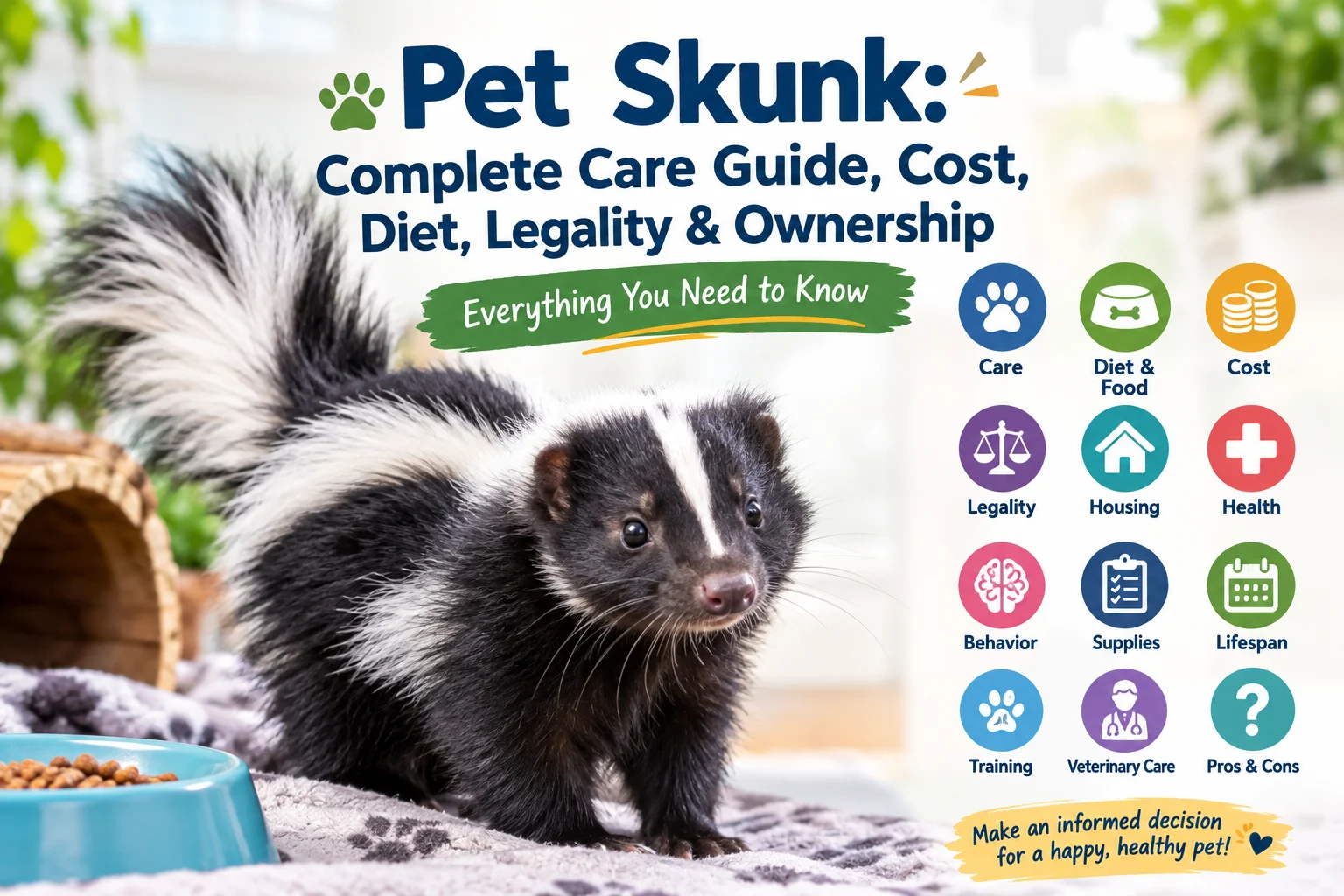
Pet Skunk: Complete Care Guide, Cost, Diet, Legality & Ownership
Thinking about getting a pet skunk? Skunks are highly intelligent animals that are curious and often surprisingly social if they are properly raised and handled. However, they are also exotic pets that have specific dietary, housing, veterinary care, and legal needs to be met.
Before jumping into getting a pet skunk, you need to do some research on more than just how much it costs. You should know how much it will cost to feed and care for a pet skunk, what kind of food to feed them.
What they need in terms of a habitat, their behavior patterns, if they can be litter trained, and if it is even legal to own one in your area. This pet skunk guide covers everything from the care and diet to the cost, behavior and needs, supplies, health, lifespan, descanting, and U. S. ownership laws to help you make the right choice.
What Is a Pet Skunk?
A pet skunk is a skunk that has been bred or raised in captivity and socialized around people. Domestic skunks are different from wild skunks in important ways, particularly in their familiarity with human handling and their behavior around people.
Skunks are considered exotic pets because they have care requirements that differ from common household animals such as dogs and cats.
A well-socialized skunk can be curious, playful, intelligent, and affectionate with its owner. However, individual temperament varies, and owning one requires a commitment to specialized care.
Wild skunks should never be treated as ordinary pets. If you encounter a wild skunk, contact appropriate wildlife professionals rather than attempting to capture or domesticate it.
Are Skunks Good Pets?
Skunks can be good companions for experienced owners who understand their needs, but they are not ideal pets for everyone.
Advantages of Having a Pet Skunk
- Intelligent and curious
- Can develop a bond with people
- Often have unique personalities
- Can learn routines
- May be litter trained
- Enjoy interactive enrichment
- Interesting alternative to traditional pets
Challenges of Owning a Pet Skunk
- Ownership may be restricted by local laws
- They require a specialized diet
- Exotic-animal veterinary care may be necessary
- They need daily enrichment
- Skunks can dig and explore
- They may require extensive pet-proofing
- Veterinary emergencies can be expensive
- Finding an experienced skunk veterinarian can be difficult
A skunk may be rewarding for the right household, but it should not be considered a low-maintenance pet.
Can You Legally Own a Pet Skunk?
Pet skunk laws vary throughout the United States.
Some states or local jurisdictions may allow skunk ownership under specific conditions, while others restrict or prohibit private ownership. Rules can involve permits, wildlife regulations, captive-bred requirements, import restrictions, or local ordinances.
Before obtaining a skunk, check:
- Your state wildlife agency
- State animal regulations
- County regulations
- City or municipal ordinances
- Exotic-pet permits
- Captive-bred animal requirements
- Veterinary or vaccination requirements
Do not rely on an old online list of “legal skunk states.” Laws and regulations can change.
How to Check If a Pet Skunk Is Legal
Search your official state government or wildlife agency website and verify the current requirements. If the rules are unclear, contact the appropriate agency directly.
Important: Legal ownership does not automatically mean that a skunk is legal in every city or county within that state.
How Much Does a Pet Skunk Cost?
The cost of a pet skunk depends on where you obtain the animal, its age, availability, location, and the setup you need.
Your total expenses can include:
| Expense | What It May Include |
|---|---|
| Initial animal cost | Breeder or adoption fee |
| Housing | Enclosure and safety equipment |
| Food | Balanced daily diet |
| Bedding | Recurring supplies |
| Litter | Litter and litter box |
| Toys | Enrichment items |
| Carrier | Transportation and veterinary visits |
| Veterinary care | Exams and treatment |
| Spay/neuter | Where recommended and available |
| Permits | Where legally required |
| Emergency care | Unexpected medical expenses |
The purchase price is only one part of the total cost.
Pet Skunk First-Year Costs
The first year can be considerably more expensive because you may need to purchase housing, supplies, veterinary services, and other equipment in addition to obtaining the animal.
For that reason, prospective owners should create a pet budget before bringing a skunk home.
Tip: Don’t choose a skunk based only on its purchase price. The ongoing cost of food, veterinary care, housing, enrichment, and emergencies can be much more important over the animal’s lifetime.
What Do Pet Skunks Eat?
A pet skunk needs a balanced, species-appropriate diet.
Skunks are omnivores, but that does not mean they should simply eat whatever human food is available. A domestic skunk’s diet needs to be carefully managed to reduce the risk of nutritional deficiencies and obesity.
Depending on veterinary guidance, an appropriate diet may include combinations of:
- Suitable protein sources
- Vegetables
- Limited fruits
- Appropriate insects
- Eggs or other suitable foods
- Species-appropriate nutritional products
- Fresh drinking water
The exact diet should be tailored to the individual animal’s age, size, activity level, health, and veterinary recommendations.
Pet Skunk Feeding Schedule
A consistent feeding routine can make it easier to monitor appetite and weight.
A general routine may include:
Morning: Balanced meal and fresh water
During the day: Appropriate enrichment or a small suitable treat when appropriate
Evening: Balanced meal
Throughout the day: Clean drinking water
Avoid excessive treats and high-calorie human foods. Obesity is an important concern for captive skunks.
If your skunk suddenly stops eating or shows a major change in appetite, contact an exotic-animal veterinarian.
Foods to Avoid Giving a Pet Skunk
Owners should avoid making processed human foods a regular part of a skunk’s diet.
Be especially cautious with:
- Highly processed foods
- Excessively salty foods
- Very sugary foods
- Excessively fatty foods
- Chocolate
- Alcohol
- Foods containing toxic ingredients
- Large amounts of treats
When you are uncertain about a particular food, ask a veterinarian experienced with skunks or other exotic mammals.
Pet Skunk Housing Requirements
A pet skunk needs a secure, clean, stimulating environment.
Important housing considerations include:
- A secure enclosure or pet-proofed living area
- Comfortable bedding
- A hiding area
- Food and water bowls
- A litter area
- Safe toys
- Digging and foraging opportunities
- Appropriate temperature
- Escape prevention
- Regular cleaning
Skunks are naturally curious and may investigate almost everything around them. Your home should therefore be thoroughly pet-proofed.
Secure cabinets, electrical cords, small openings, toxic substances, and other hazards before allowing a skunk to explore.
Pet Skunk Supplies Checklist
Before bringing a skunk home, prepare the basic supplies first.
Pet Skunk Checklist
☐ Secure enclosure or safe living area
☐ Food and water bowls
☐ Appropriate food
☐ Fresh water
☐ Litter box
☐ Suitable litter
☐ Bedding
☐ Hiding area
☐ Toys
☐ Digging and enrichment materials
☐ Pet carrier
☐ Cleaning supplies
☐ Grooming supplies
☐ Emergency veterinarian contact
☐ Safe storage for food and household chemicals
Having supplies ready before adoption or purchase makes the transition easier and safer.
Pet Skunk Behavior and Temperament
Skunks are intelligent animals with strong natural behaviors.
Common behaviors can include:
- Digging
- Exploring
- Foraging
- Investigating objects
- Searching for food
- Hiding
- Playing
- Establishing routines
A skunk that receives appropriate socialization and enrichment may become comfortable around its human caregivers.
However, a skunk is still an animal with its own instincts and personality. Never assume that every skunk will behave exactly the same way.
Can a Pet Skunk Be Litter Trained?
Some domestic skunks can learn to use a litter box, but training requires patience and consistency.
To encourage litter-box habits:
- Place the litter box in an accessible location.
- Watch for signs that your skunk needs to eliminate.
- Place it in the litter area at appropriate times.
- Reward desirable behavior.
- Clean accidents thoroughly.
- Maintain a consistent routine.
Litter training may take time, and individual skunks can have different habits.
Do Pet Skunks Smell?
Skunks are famous for their defensive odor, but there is an important distinction between skunk spray and normal body odor.
Wild skunks use scent as a defense mechanism. Domestic skunks may undergo procedures commonly described as “descenting,” but this does not make them maintenance-free animals.
Odor management also depends on:
- Clean bedding
- Regular enclosure cleaning
- Good hygiene
- Proper diet
- Veterinary care
- Appropriate housing
Never assume that owning a domestic skunk means there will be absolutely no odor.
What Does “Descented Skunk” Mean?
“Descented” generally refers to a skunk that has had its scent glands surgically removed.
Anyone considering such a procedure should discuss it with a qualified veterinarian and understand the legal, medical, and animal-welfare considerations in their area.
A descented skunk still requires proper care, and descenting does not remove the need for responsible ownership.
Pet Skunk Exercise and Enrichment
Skunks need opportunities to explore and use natural behaviors.
Useful enrichment can include:
- Supervised exploration
- Food puzzles
- Foraging activities
- Safe digging opportunities
- Toys
- Hiding areas
- Rotating enrichment activities
Mental stimulation is particularly important for intelligent and curious animals.
A boring environment can contribute to undesirable behaviors, so enrichment should be part of the normal daily routine.
Pet Skunk Health Problems
Captive skunks can experience health problems associated with nutrition, weight, parasites, dental health, injuries, and other conditions.
Potential concerns can include:
- Obesity
- Nutritional deficiencies
- Dental problems
- Parasites
- Digestive problems
- Skin abnormalities
- Mobility problems
- Neurological symptoms
- Reproductive problems
Regular veterinary care is important because early changes in behavior or appetite can sometimes indicate an underlying health problem.
When Should You Take a Pet Skunk to a Veterinarian?
Contact a veterinarian if your skunk develops concerning symptoms such as:
- Loss of appetite
- Severe lethargy
- Difficulty breathing
- Persistent vomiting
- Persistent diarrhea
- Sudden weakness
- Seizures
- Difficulty walking
- Major weight changes
- Unusual behavior
- Significant injury
Because skunks are exotic animals, it is best to identify a veterinarian who is willing and qualified to treat them before an emergency happens.
How to Find a Veterinarian for a Pet Skunk
Not every veterinary clinic treats skunks.
Before getting one, call local clinics and ask:
- Do you treat pet skunks?
- Do you treat exotic mammals?
- Do you provide emergency care?
- Do you perform routine examinations?
- Do you provide dental care?
- Do you provide reproductive services?
- What should I do after hours?
Having this information in advance can save valuable time during an emergency.
How Long Do Pet Skunks Live?
A pet skunk’s lifespan can vary depending on genetics, nutrition, veterinary care, environment, weight, and other factors.
Responsible ownership should therefore be considered a long-term commitment.
Instead of focusing only on the animal’s expected lifespan, prospective owners should ask whether they can provide consistent care throughout the animal’s entire life.
Pet Skunk Pros and Cons
| Pros | Cons |
|---|---|
| Intelligent | Specialized care |
| Curious | Legal restrictions |
| Unique personality | Exotic veterinarian may be needed |
| Can bond with people | Digging and exploring |
| May learn routines | Diet requires attention |
| Can be entertaining | Emergency care can be expensive |
| Interesting companion | Not suitable for every household |
The best pet is not necessarily the most unusual one. Choose an animal whose needs fit your lifestyle, budget, housing, and experience.
Pet Skunk vs Other Pets
Before choosing a skunk, compare it with other animals you may be considering.
| Factor | Pet Skunk | Ferret | Guinea Pig | Cat |
|---|---|---|---|---|
| Care complexity | High | Moderate | Moderate | Moderate |
| Diet | Specialized | Specialized | Specialized | Specialized |
| Veterinary needs | Exotic care may be needed | Exotic care may be needed | Exotic care may be needed | Widely available |
| Legal restrictions | Possible | Possible | Usually fewer | Usually fewer |
| Enrichment | High | High | Moderate | Moderate–High |
| Unique behavior | Very high | High | Moderate | High |
The right choice depends on your household, budget, available veterinary care, and local regulations.
Where Can You Get a Pet Skunk?
If skunks are legal in your area, prospective owners should research responsible sources such as reputable breeders or legitimate rescue organizations.
Before obtaining a skunk, ask for:
- Health information
- Animal history
- Feeding information
- Veterinary records
- Legal documentation where applicable
- Information about socialization
- Details about the animal’s age
- Information about previous care
Never capture a wild skunk and attempt to turn it into a household pet.
If you cannot answer “yes” to these questions, take more time to research before obtaining a skunk.
Pet Skunk First-Year Budget
Your first-year budget should include both startup and recurring expenses.
Startup expenses
- Animal or adoption fee
- Enclosure
- Carrier
- Food and water equipment
- Litter supplies
- Bedding
- Toys
- Initial veterinary examination
Recurring expenses
- Food
- Litter
- Bedding
- Enrichment
- Routine veterinary care
- Medication when needed
- Replacement supplies
Emergency expenses
Always maintain an emergency fund because exotic-animal veterinary treatment can be difficult to predict.
A pet-cost calculator can help you estimate the total before making a commitment.
Is a Pet Skunk Right for You?
A pet skunk may be a fascinating companion for someone prepared to provide specialized care, but it is not a simple alternative to owning a dog or cat.
Before getting one, evaluate four things:
Legality: Can you legally own one?
Care: Can you provide the appropriate diet, housing, enrichment, and veterinary care?
Cost: Can you afford both routine and unexpected expenses?
Commitment: Can you provide responsible care for the animal throughout its life?
If the answer to all four is yes, continue researching reputable sources and qualified veterinary care before making a decision.
Final Verdict: Should You Get a Pet Skunk?
Pet skunks can be rewarding companions, but they are best suited to owners who understand exotic-animal care and are prepared for the responsibilities involved.
The most important step is to research the animal before acquiring it. Check local laws, identify an experienced veterinarian, prepare suitable housing, understand the diet, estimate your budget, and plan for emergencies.
A responsible pet owner should choose an animal based on its needs—not simply because it is unusual or interesting.
FAQs About Pet Skunks
Can you have a pet skunk?
It depends on where you live. State, county, and city regulations may restrict or prohibit skunk ownership. Always verify current laws before obtaining one.
Are skunks good pets?
Skunks can make interesting companions for experienced owners, but they require specialized care and may not be appropriate for every household.
How much does a pet skunk cost?
The total cost includes the animal, housing, food, litter, enrichment, veterinary care, permits where required, and emergency expenses. Costs vary considerably by location and individual circumstances.
What do pet skunks eat?
Pet skunks need a balanced, species-appropriate omnivorous diet. Their food should be carefully managed to provide appropriate nutrition and help prevent obesity.
Can pet skunks be litter trained?
Some domestic skunks can learn to use a litter box, although success varies between individual animals and requires consistent training.
Do pet skunks smell?
Skunks have scent glands associated with their famous defensive spray. Domestic skunks may be descented, but owners still need to maintain good hygiene and clean housing.
How long do pet skunks live?
Lifespan varies according to genetics, nutrition, veterinary care, environment, and other factors.
Do pet skunks need a special veterinarian?
It is strongly recommended to find a veterinarian who is experienced and willing to treat skunks or other appropriate exotic mammals.
Can I keep a wild skunk as a pet?
You should not capture a wild skunk and attempt to domesticate it. Wild animals have different needs and may be subject to wildlife laws.
What supplies does a pet skunk need?
Basic supplies can include secure housing, food and water bowls, suitable food, bedding, litter supplies, toys, enrichment materials, a carrier, and cleaning equipment.
Final Takeaway
A pet skunk is a unique commitment that requires careful planning. Before bringing one home, research its legal status, diet, housing, behavior, veterinary needs, and total cost.
The goal should not simply be to find a skunk—it should be to make sure you can provide a safe, healthy, enriching, and legally compliant home.
For more practical pet ownership information, explore PetConearMe’s guides on pet costs, affordable pets, pet supplies, grooming, veterinary care, and other small and exotic pets.