

Cheap Pets to Adopt: 15 Affordable Animals & Their Real Costs
You want to adopt a low-cost pet, so that you can bring home. That little life that will keep you company and love. You without having to spend a huge sum of money right at the start. Many prospective pet owners worry at first.
The upfront investment is too high, that they cannot come up with a large amount of start-up funds, and adopting a low-cost pet is just the way to avoid this problem, so you can start your life of pet ownership smoothly.
However, Cheap Pets to Adopt the fee you pay when adopting is only a small part of all the money you will spend raising it; do not only look at that fee and think you have calculated all the expenses. You have to buy food for it, take it to the veterinary clinic when it is sick, prepare a bed for it to live in.
All kinds of daily items it needs such as food bowls and leashes, spend money to groom its fur, also pay for costs to train it, and if it suddenly comes down with an emergency illness, you have to pay for unforeseen medical bills.
When you add up all these miscellaneous expenses, they will quickly push your original pet-raising budget far beyond what you planned, and the money you set aside earlier will most likely not be enough. More than one with a $100 fee if it needs specialized care or expensive supplies.
What Are the Cheap Pets to Adopt?

The cheapest pet to adopt depends on where you live, which shelters are available, and what services are included in the adoption fee.
Some shelters periodically offer reduced-fee or fee-waived adoption events. Others include valuable services such as vaccinations, microchipping, and spay/neuter surgery in the adoption fee.
Here are 15 types of pets worth considering when you’re looking for an affordable companion:
- Adult cats
- Senior cats
- Adult dogs
- Senior dogs
- Mixed-breed dogs
- Rabbits
- Guinea pigs
- Hamsters
- Rats
- Mice
- Gerbils
- Birds
- Fish
- Turtles
- Other small animals available through local rescues
Remember that low adoption cost does not necessarily mean low ownership cost. Every species has different housing, food, veterinary, and environmental requirements.
The cheapest pet to adopt depends on where you live, which shelters are available, and what services are included in the adoption fee.
Some shelters periodically offer reduced-fee or fee-waived adoption events. Others include valuable services such as vaccinations, microchipping, and spay/neuter surgery in the adoption fee.
Here are 15 types of pets worth considering when you’re looking for an affordable companion:
- Adult cats
- Senior cats
- Adult dogs
- Senior dogs
- Mixed-breed dogs
- Rabbits
- Guinea pigs
- Hamsters
- Rats
- Mice
- Gerbils
- Birds
- Fish
- Turtles
- Other small animals available through local rescues
Remember that low adoption cost does not necessarily mean low ownership cost. Every species has different housing, food, veterinary, and environmental requirements.
15 Cheap Pets to Adopt and What to Consider
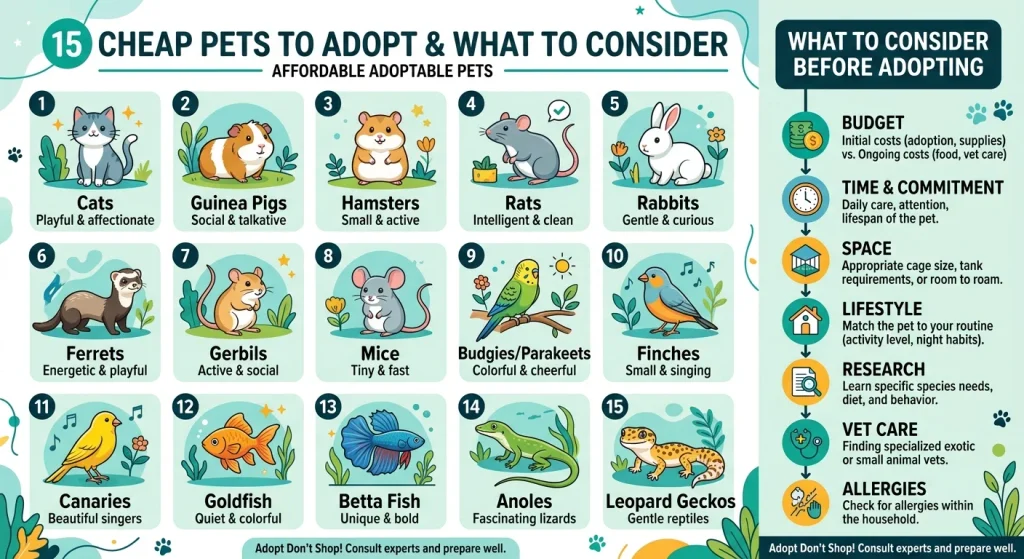
Adult Cats
Adult cats can be an excellent choice for people who want a companion without the intensive training and supervision often associated with kittens.
An adult cat may already be litter-trained and have an established personality, making it easier to determine whether the animal fits your household.
Before adoption, ask the shelter about vaccinations, spay/neuter status, microchipping, medical history, food requirements, and any ongoing medications.
Senior Cats
Senior cats can sometimes be overlooked by adopters who want kittens. However, older cats may make wonderful companions for people who prefer a calmer household.
Some organizations offer special adoption programs or reduced fees for senior animals. Nevertheless, potential medical expenses should be considered before adoption.
A lower adoption fee does not eliminate the possibility of future veterinary costs.
Adult Dogs
Adult dogs can be a more affordable and predictable option than puppies.
Puppies may require extensive training, frequent supervision, vaccinations, toys, puppy-proofing, and other supplies. An adult dog may already have basic training and established behavior.
Ask the rescue about the dog’s exercise needs before adopting. A low-cost dog that requires several hours of daily exercise may not be the right choice for a busy household.
Senior Dogs
Senior dogs may be available through shelters and rescues at reduced adoption fees.
They can be excellent companions for people who prefer a calmer lifestyle. However, older dogs can also have age-related medical needs.
Before adopting, ask for available veterinary records and discuss known health concerns with the shelter.
Mixed-Breed Dogs
Mixed-breed dogs can be excellent adoption candidates because shelters and rescues have many different sizes, personalities, and energy levels.
Instead of choosing a dog based only on appearance, consider its temperament, adult size, exercise requirements, and behavior around children or other animals.
Choosing a dog that fits your lifestyle can help reduce future problems and unexpected expenses.
Rabbits
Rabbits can be affectionate and entertaining pets, but they should not be treated as inexpensive cage animals.
They need appropriate housing, a suitable diet, enrichment, regular cleaning, and veterinary care. Their living environment also needs enough space for normal movement and exercise.
Before adopting a rabbit, calculate the cost of its habitat, food, litter, toys, and veterinary care.
Guinea Pigs
Guinea pigs can be appealing small pets, particularly for households that have limited space.
However, they still require proper nutrition, a suitable enclosure, clean bedding, enrichment, and veterinary attention when necessary.
Because guinea pigs are social animals, prospective owners should also research whether keeping compatible guinea pigs together is appropriate for their situation.
Hamsters
Hamsters are small, but their care requirements should not be underestimated.
A suitable enclosure, bedding, food, enrichment, and veterinary care all contribute to ownership costs.
The animal itself may be inexpensive to adopt, but purchasing an appropriate habitat can cost more than the adoption fee.
Rats
Pet rats can be intelligent, social, and interactive companions.
They need an appropriately sized enclosure, enrichment, food, bedding, and regular cleaning. Their relatively small size does not mean they require minimal care.
Research their social and environmental needs before adoption.
Mice
Mice may have relatively low initial costs compared with larger animals, but they still need proper housing, food, bedding, enrichment, and veterinary care.
Their small size can make them suitable for some households, but they are not maintenance-free pets.
Gerbils
Gerbils can be another small-pet option for people who want an animal that does not require the space of a dog.
Before adopting, investigate enclosure requirements, diet, bedding, enrichment, and social needs.
The habitat can be one of the biggest initial expenses.
Birds
Some birds can be affordable to adopt, especially when adoption organizations have birds looking for new homes.
However, bird ownership can involve cage costs, specialized food, toys, enrichment, and veterinary care.
Different bird species also have dramatically different lifespans and care requirements.
Fish
Fish can have a relatively low adoption or purchase price, but the aquarium setup can be a significant initial expense.
You may need:
- Aquarium
- Filter
- Heater, depending on species
- Lighting
- Water conditioner
- Substrate
- Decorations
- Food
- Water-testing equipment
The ongoing maintenance of water quality is essential for fish health.
Turtles
Turtles can live for many years and may require specialized habitats.
Depending on the species, owners may need appropriate lighting, heating, filtration, water or land areas, and specialized nutrition.
A turtle should never be selected simply because it appears inexpensive to obtain.
Other Small Animals
Local shelters and rescues may have other small animals available for adoption.
Availability varies widely by location. Before adopting, research the species-specific requirements rather than choosing solely based on the lowest adoption fee.
Cheap Pets to Adopt Fee

Adoption fees vary by organization and location, so there is no nationwide price that applies to every animal.
Instead of ranking pets by one fixed dollar amount, compare the actual package of services included with the adoption.
For example, consider two animals:
$25 adoption fee but requires vaccinations, sterilization, and a veterinary examination.
$100 fee with vaccinations, sterilization, microchip, and an initial veterinary examination included.
Pet B may actually represent the better financial value.
That’s why the question should not simply be:
“What is the cheapest pet?”
A better question is:
“Which pet gives me the best overall value while allowing me to provide proper care?”
Cheap Pets to Adopt Monthly Budget
Your monthly budget is often more important than the adoption fee.
Consider creating a pet budget before visiting a shelter.
Under $25 per month
This is an extremely limited budget for most traditional pets. Food and basic supplies alone may exceed this amount.
Rather than adopting immediately, build an emergency fund first.
$25–$50 per month
Some small pets may potentially fit within this range depending on food, supplies, veterinary needs, and local prices.
However, veterinary emergencies can quickly exceed the normal monthly budget.
$50–$100 per month
This gives you more flexibility for certain small pets and some cats, although individual expenses vary considerably.
$100–$150 per month
This can provide a more realistic budget for many cats and some dogs, depending on size, food requirements, healthcare, grooming, and other expenses.
$150+ per month
A larger budget provides more room for food, preventive care, grooming, enrichment, insurance, savings, and unexpected expenses.
The key is to budget for both routine and emergency costs.
What Does a Cheap Pets to Adopt Fee Include?
One of the most overlooked questions when comparing cheap pets is:
What exactly am I getting for the adoption fee?
Depending on the shelter or rescue, the fee may include some combination of:
- Spay or neuter surgery
- Vaccinations
- Microchip
- Initial veterinary examination
- Parasite treatment
- Identification
- Testing
- Starter supplies
Ask the organization for a complete list before comparing adoption fees.
A higher adoption fee can sometimes save you money because important veterinary services have already been provided.
Are Cheap Pets to Adopt Really Free?
No. A free pet is not a free pet.
A fee-waived or free adoption can reduce your initial expense, but you still need to pay for ongoing care.
Your budget may include:
Initial costs
- Food and bowls
- Bed or enclosure
- Collar and leash
- Litter box
- Bedding
- Toys
- Cleaning supplies
- Veterinary examination
Recurring costs
- Food
- Litter or bedding
- Preventive healthcare
- Grooming
- Replacement toys
- Cleaning supplies
Unexpected costs
- Illness
- Injuries
- Emergency veterinary visits
- Medication
- Specialized diets
Therefore, never adopt an animal simply because the adoption fee is zero.
Adult vs. Puppy or Kitten: Which Costs Less?
For many households, an adult pet can be financially easier to plan for than a puppy or kitten.
Young animals may require additional vaccinations, training, toys, supplies, and supervision. Puppies can also need puppy-proofing and training classes.
Adult animals may already have some basic training and established habits.
However, every animal is different. An adult pet can still have medical or behavioral needs that affect the overall cost.
The best choice is the animal whose needs match your budget and lifestyle.
Are Senior Cheap Pets to Adopt?
Senior pets may sometimes have reduced adoption fees or special adoption programs.
However, don’t assume that a senior pet will always be cheaper overall.
Potential benefits include:
- Often calmer behavior
- Established personality
- May already have basic training
- Sometimes reduced adoption fees
Potential concerns include:
- Increased veterinary needs
- Prescription medications
- Age-related conditions
- Potentially shorter remaining lifespan
Ask the shelter for the animal’s available medical records and discuss any known health concerns before making your decision.
Cheapest Pets for Apartments, Families and Beginners
The cheapest pet for you depends on your circumstances.
Best affordable pet for apartment living
An adult cat may be a good option for some apartment households because cats generally do not require outdoor walks.
Best affordable pet for active families
An adult dog may work well if your family has enough time for exercise, training, socialization, and daily care.
Best affordable pet for beginners
A pet with predictable care requirements and a temperament that matches your experience may be easier for a first-time owner.
Best affordable small pet
Small animals can require less physical space, but their habitats and species-specific care still need to be properly planned.
There is no universally “cheapest” pet that is suitable for every household.
Hidden Costs to Check Before Adoption
Before adopting, ask yourself what expenses could appear after you bring the animal home.
Look beyond the adoption fee and consider:
Veterinary care: Routine examinations and unexpected medical treatment can become significant expenses.
Food: Larger animals generally consume more food, but specialized diets can also increase costs.
Housing: Aquariums, cages, habitats, beds, and other equipment can require a substantial initial investment.
Grooming: Some dogs and other pets require regular professional grooming.
Training: Professional training may be useful for some dogs and behavioral situations.
Pet sitting: Travel can create additional expenses if you need someone to care for your pet.
Emergency fund: Every pet owner should consider setting aside money for unexpected veterinary expenses.
How to Find Low-Cost Pet Adoption Near You
Start with local animal shelters, humane organizations, municipal shelters, and nonprofit rescues.
Search for:
- “cheap pets to adopt near me”
- “low-cost pet adoption near me”
- “fee waived pet adoption”
- “animal shelter adoption”
- “senior pet adoption”
- “pet adoption event”
Adoption websites can also help you search animals from shelters and rescues by location.
Before visiting, check the organization’s current adoption policies, fees, included medical services, eligibility requirements, and available animals.
Adoption events can sometimes offer reduced fees, but always confirm the current terms directly with the organization.
Cheap Pet Adoption Cost Calculator
Wondering how much an adopted pet could cost? Enter your estimated adoption fee, setup costs, monthly expenses, and emergency budget to estimate your first-year pet cost.
Your Estimated Pet Costs
Pet:
Adoption Fee: $
Initial Setup: $
12 Months of Regular Costs: $
Emergency/Vet Savings: $
Estimated First-Year Cost:
Estimated Average Monthly Cost: $
Important: This calculator provides an estimate only. Actual pet adoption and ownership costs vary by animal, location, shelter, veterinary needs, food, supplies, and lifestyle. Emergency veterinary expenses can be higher than the amount entered above.
Final Verdict: What Is the Cheapest Pet to Adopt?
The cheapest pet to adopt isn't necessarily the animal with the lowest adoption fee.
For many people, an adult cat or another appropriately matched shelter animal can offer an affordable path to pet ownership. Small animals may have lower food costs, but their habitats and specialized care can still add up. Dogs can provide wonderful companionship but may require a larger budget for food, exercise, training, grooming, and healthcare.
The smartest approach is to compare adoption cost, first-year expenses, monthly costs, veterinary needs, housing requirements, and your lifestyle.
Most importantly, choose an animal because you can provide the care it needs—not simply because it is inexpensive.
A responsible adoption decision can save money while also giving a deserving animal a permanent, loving home.
FAQs
What is the cheapest pet to adopt?
There is no single cheapest pet nationwide because adoption fees and care costs vary. Adult cats, small animals, and fee-waived shelter pets may sometimes be affordable options.
Can I adopt a pet for free?
Yes, some shelters and rescues periodically offer fee-waived or reduced-fee adoptions. However, you will still need to pay for food, supplies, veterinary care, and other ongoing expenses.
What pets cost less than $50 to adopt?
Some shelters may offer cats, dogs, rabbits, guinea pigs, and other animals for less than $50 during certain promotions or based on the animal's age and circumstances. Prices vary by organization and location.
Is adopting cheaper than buying a pet?
Adoption can reduce the initial cost of obtaining a pet, particularly when veterinary services are included in the adoption fee. However, total ownership costs depend on the animal's individual needs.
Are senior pets cheaper?
Senior pets may sometimes have reduced adoption fees, but they can also require additional veterinary care. Consider both the initial fee and potential long-term costs.
What is the cheapest pet for a beginner?
There is no universally best beginner pet. Choose an animal whose care requirements, temperament, lifespan, and costs fit your experience and lifestyle.
How can I save money when adopting a pet?
Compare shelters and rescues, look for adoption events, ask what veterinary services are included, consider adult animals, and create a realistic monthly and emergency budget before adoption.