

Pocket Pets: 10 Best Small Pets, Costs, Care & How to Choose
The best pocket pet for you depends on your budget, available space, schedule, experience and the type of relationship you want with your pet.
In this guide, you’ll compare popular pocket pets by cost, lifespan, social needs, activity level, handling, care difficulty and suitability for beginners, families and apartments. You’ll also learn what to buy before bringing one home and why a low purchase price does not always mean low ownership costs.
Quick answer: There is no single best pocket pet for everyone. Hamsters can suit people wanting a smaller, mostly independent companion, guinea pigs are popular with families that can provide adequate space and companionship, and rats are highly interactive and intelligent. The right choice depends on your lifestyle—not just the purchase price. Cheapest pets to own
What Are Pocket Pets and What Counts as One?
“Pocket pet” is an informal term commonly used for small companion animals, particularly small mammals such as hamsters, guinea pigs, rats, mice and gerbils. Depending on the source, the category may also include rabbits, chinchillas, ferrets, hedgehogs, degus and sugar gliders.
The important thing to understand is that pocket pets are not one type of animal. Their care requirements can be dramatically different.
For example, some small mammals are naturally social and may need compatible companions, while others are generally housed alone. Activity patterns also differ: some are most active at night, while others are easier to interact with during the day.
That means choosing by appearance alone can lead to the wrong match.
Best Pocket Pets at a Glance: Comparison Chart
| Pocket Pet | Best For | Typical Lifespan | Social Needs | Activity | Care Level |
|---|---|---|---|---|---|
| Hamster | Solo owners & small spaces | About 2–3 years | Usually solitary | Mostly evening/night | Easy–Moderate |
| Guinea Pig | Families & daytime interaction | About 4–8 years | Social | Day & night | Moderate |
| Fancy Rat | Bonding & training | About 2–3 years | Highly social | Flexible/evening | Moderate |
| Gerbil | Active observers | About 3–4 years | Social | Often evening/night | Moderate |
| Mouse | Small-space owners | About 1–3 years | Social, depending on sex/species | Mostly night | Moderate |
| Chinchilla | Experienced owners | About 10–20 years | Social | Mostly evening/night | Moderate–High |
| Rabbit | Owners wanting a long-term companion | About 8–12 years | Social | Most active dawn/dusk | High |
| Ferret | Interactive, playful owners | About 6–10 years | Social | Active periods throughout day | High |
| Hedgehog | Experienced owners wanting a solitary pet | About 3–6 years | Usually solitary | Nocturnal | Moderate |
| Degu | Owners who enjoy social rodents | About 6–9 years | Social | Day/evening | Moderate–High |
Important: Lifespans and care requirements vary by species, genetics, diet, housing and veterinary care. Always research the specific animal before adopting or purchasing.
Which Pocket Pet Is Best for You?
Instead of asking “What is the best pocket pet?”, ask what you actually want from your pet.
Best pocket pet for beginners
A hamster can be a reasonable option for someone who wants a relatively small companion and understands its nocturnal lifestyle. Guinea pigs may suit families seeking a more social, daytime-active animal, while rats can be a great choice for owners who want interaction and training.
Beginner-friendly does not mean maintenance-free. Every pocket pet needs appropriate housing, nutrition, enrichment, cleaning and veterinary care.
Best pocket pet for kids
Guinea pigs are often considered a better family choice than many nocturnal or more delicate small mammals because they can be active during the day and can become comfortable with gentle handling.
However, an adult should remain responsible for the animal’s welfare. A child should not be expected to be the sole caregiver.
Best pocket pet for apartments
Small mammals can work well in apartments, but enclosure size, ventilation, noise, smell and exercise requirements still matter.
Hamsters, gerbils, mice and rats can fit apartment lifestyles, but they are not automatically “tiny cage” pets. Their habitats must be large and appropriately designed for the species.
Best pocket pet for cuddling
If handling and companionship are your top priorities, consider guinea pigs and well-socialized rats.
Hamsters can be rewarding but are often active when people are sleeping and may dislike being disturbed during the day.
Rabbits can bond strongly with people but often prefer interaction on the floor rather than being picked up.
Best pocket pet for a tight budget
Purchase price is only one part of the budget.
Hamsters and gerbils may have lower initial costs than larger small mammals, but every animal still needs a suitable enclosure, food, bedding, enrichment and veterinary care.
A cheap animal can become an expensive pet if its habitat or healthcare needs are underestimated.
10 Popular Pocket Pets Compared
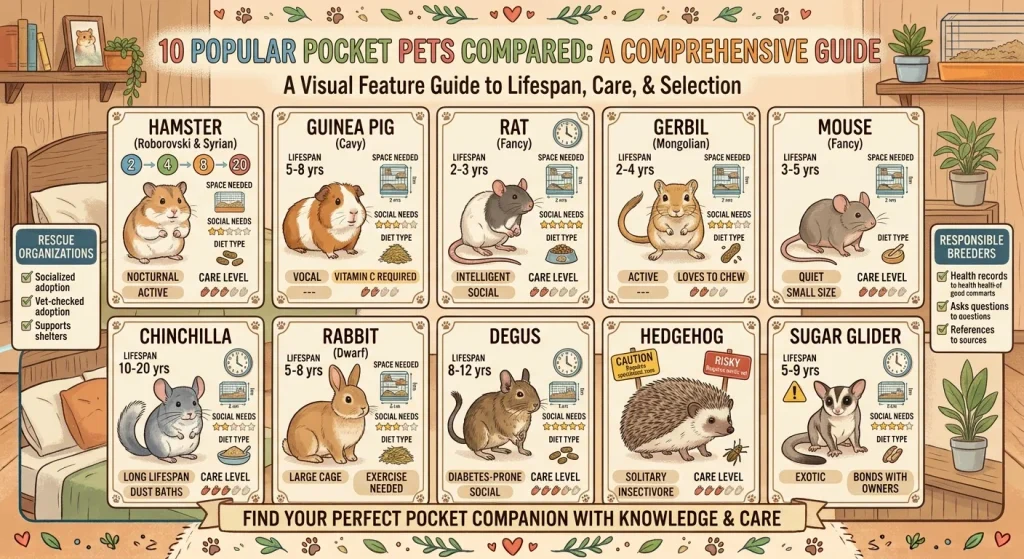
1. Hamsters
Hamsters are among the most recognizable pocket pets. They are small, entertaining and generally suited to owners who want a companion that does not require constant daytime interaction.
Most pet hamsters are active primarily during the evening and night. Their habitat should provide enough room for movement, appropriate bedding for digging and burrowing, enrichment and a properly sized exercise wheel.
Hamsters are often kept alone, but housing requirements depend on the species. Syrian hamsters, for example, are generally solitary.
Best for: People who want a small, mostly independent pet.
Watch out for: Nocturnal behavior, improper cage sizes and waking a sleeping hamster.
2. Guinea Pigs
Guinea pigs are social herbivores known for their vocal personalities and daytime activity.
They need a spacious enclosure, a high-fiber diet based around appropriate hay, fresh water and suitable sources of vitamin C. They also benefit from enrichment, exercise and companionship.
Guinea pigs are social animals, so their social needs should be considered before bringing one home.
Best for: Families and owners who want daytime interaction.
Watch out for: Space requirements, diet, veterinary care and companionship needs.
3. Fancy Rats
Pet rats are intelligent, curious and highly interactive. They can learn behaviors and often form strong relationships with their owners.
Because rats are social animals, they generally do best with compatible rat companions rather than living alone.
Best for: Owners who want a highly interactive and trainable small pet.
Watch out for: Short lifespan, social requirements and the need for daily interaction.
4. Gerbils
Gerbils are energetic little rodents that spend much of their time digging, exploring and interacting with their environment.
They can be fascinating pets for people who enjoy watching natural behaviors such as burrowing.
Best for: Owners who enjoy active, entertaining small mammals.
Watch out for: Social compatibility and providing enough digging and enrichment opportunities.
5. Mice
Mice are extremely small and can be fascinating to observe.
They are social animals in many circumstances, but appropriate grouping depends on sex, species and individual compatibility.
Best for: Owners with limited space who enjoy observing rather than constantly handling their pets.
Watch out for: Their small size, fast movements and social needs.
6. Chinchillas
Chinchillas are famous for their exceptionally soft fur and can live considerably longer than many other pocket pets.
They have specialized environmental and care requirements and can be less suitable for first-time owners.
They are also sensitive to excessive heat, making temperature management particularly important.
Best for: Experienced owners prepared for a long-term commitment.
Watch out for: Heat, specialized care and their longer lifespan.
7. Rabbits
Sometimes grouped with pocket pets because they are small compared with dogs and many other companion animals, but they should not be treated like cage-only rodents.
Rabbits need considerably more space, exercise, enrichment and long-term commitment than many people expect.
Their lifespan can also be much longer than that of hamsters or rats.
Best for: Owners prepared for a substantial long-term commitment.
Watch out for: Space, diet, exercise, veterinary expenses and lifespan.
8. Ferrets
Ferrets are playful, curious and highly interactive, but they are not necessarily low-maintenance pets.
They need appropriate housing, enrichment, exercise, supervision and veterinary care.
Best for: Experienced owners who want an energetic and interactive animal.
Watch out for: Odor, exercise, enrichment, supervision and specialist veterinary care.
9. Hedgehogs
Hedgehogs are solitary, nocturnal animals with specialized care requirements.
They may appeal to people who want a less conventional small pet, but their care needs should be researched carefully before adoption.
Best for: Experienced owners interested in an unusual companion.
Watch out for: Nocturnal activity, temperature requirements and veterinary access.
10. Degus
Degus are social rodents that are active during daylight and require appropriate companionship, housing and diet.
They can be rewarding for experienced small-mammal owners who enjoy observing social and exploratory behavior.
Best for: Owners looking for a social, daytime-active rodent.
Watch out for: Diet, social needs and specialized care.
How Much Do Pocket Pets Cost?
The purchase price of a pocket pet can be misleading.
The real cost includes:
- Adoption or purchase fee
- Enclosure
- Bedding or substrate
- Food
- Hay or fresh produce where required
- Water equipment
- Exercise equipment
- Hides and enrichment
- Cleaning supplies
- Grooming supplies
- Routine veterinary care
- Emergency veterinary care
- Replacement equipment
A pet that costs $20 to acquire can still require hundreds of dollars in setup and ongoing care.
Pocket Pet Cost Categories
| Expense | Hamster | Guinea Pig | Rat | Gerbil | Rabbit |
| Animal/adoption fee | Low | Low–Moderate | Low | Low | Low–Moderate |
| Habitat | Moderate | Moderate–High | Moderate | Moderate | High |
| Food | Low | Moderate | Low–Moderate | Low | Moderate–High |
| Bedding | Low–Moderate | Moderate | Moderate | Moderate | Moderate |
| Vet care | Variable | Variable | Variable | Variable | Variable–High |
| Long-term commitment | Shorter | Medium | Shorter | Medium | Long |
The takeaway: Do not choose a pet based only on how much it costs to buy.
Cheapest Pocket Pets: Which Ones Really Cost Less?
If your priority is affordability, compare total ownership costs, not the animal’s sticker price.
Hamsters and gerbils are often among the more budget-friendly options, while rabbits and chinchillas can require substantially more space, equipment or long-term commitment.
Guinea pigs can also cost more than expected because they need appropriate space, food and social companionship.
Before choosing a pet, create a budget for at least:
- Initial setup
- Monthly food and bedding
- Routine veterinary care
- Emergency savings
- Replacement equipment
Are Pocket Pets Actually Low-Maintenance?
Some are lower-maintenance than dogs, but “low maintenance” does not mean “little care.”
Every pocket pet needs:
- Fresh food and water
- Appropriate housing
- Cleaning
- Exercise
- Enrichment
- Safe handling
- Health monitoring
- Veterinary care when needed
The time commitment can also vary dramatically between species.
A pet that spends most of its time inside an enclosure still depends completely on its owner.
Pocket Pets That Can Live Alone vs. Those That Need Companionship
This is one of the most important factors that new owners overlook.
Usually solitary
Some hamsters, particularly Syrian hamsters, are generally housed alone.
Social species
Guinea pigs, rats, gerbils, degus and some mice have important social needs.
The correct social arrangement depends on the species, sex, compatibility and individual animal.
Never assume that putting two unfamiliar animals together is automatically safe.
Research the species-specific companionship requirements before bringing home a second animal.
Are Pocket Pets Good for Children?
They can be, but the answer depends on the animal and the child.
Consider:
- The child’s age
- Ability to handle animals gently
- Noise level in the home
- Adult supervision
- Daily care requirements
- Animal activity schedule
- Expected lifespan
- Cost of care
A pocket pet should never be purchased simply because it looks like an easy “starter pet.”
An adult should be prepared to take full responsibility for the animal.
Best Pocket Pets for Small Apartments
Living in a small home does not automatically mean every small animal will be suitable.
Before choosing a pocket pet, measure the space available for:
- The enclosure
- Food storage
- Bedding storage
- Exercise
- Cleaning
- Safe out-of-enclosure time
Also consider noise.
A pet may be physically small but still need a surprisingly large habitat.
What Does a Pocket Pet Need?
Before bringing one home, prepare the habitat first.
Basic supplies
- Species-appropriate enclosure
- Safe bedding or substrate
- Food
- Fresh water
- Food dish
- Water bottle or bowl
- Hiding places
- Exercise equipment
- Chew toys where appropriate
- Enrichment
- Cleaning supplies
- Carrier for veterinary visits
- Species-appropriate grooming supplies
Do not assume that a small starter cage is automatically an appropriate permanent habitat.
Pocket Pet Habitat: Why Size Matters
One of the biggest mistakes new owners make is buying a habitat based on the animal’s body size rather than its behavioral needs.
A hamster may be tiny, but it still needs room to move, dig and explore.
Guinea pigs need substantial floor space.
Rabbits need opportunities for exercise outside their primary resting area.
Rats need vertical and horizontal space plus enrichment.
The enclosure should be selected according to the species—not simply whatever cage is cheapest.
What Do Pocket Pets Eat?
There is no universal “pocket pet diet.”
Different animals require different nutrition.
For example:
- Hamsters need a balanced species-appropriate diet.
- Guinea pigs require a fiber-rich diet and a reliable source of vitamin C.
- Rabbits depend heavily on appropriate hay and fiber.
- Rats need a balanced diet formulated for rats.
- Chinchillas require a specialized high-fiber diet.
Never feed one species a diet simply because it looks similar to another animal.
If you are unsure, ask a veterinarian experienced with small mammals.
Pocket Pet Exercise and Enrichment
A pocket pet can become bored even inside a large enclosure.
Useful enrichment can include:
- Tunnels
- Hides
- Chew-safe items
- Digging opportunities
- Food puzzles
- Climbing structures where appropriate
- Foraging opportunities
- Supervised exercise
Enrichment should encourage natural behaviors rather than simply adding more objects to a cage.
Do Pocket Pets Smell?
The animal itself is not necessarily the main source of odor.
Odor is often affected by:
- Enclosure size
- Ventilation
- Bedding
- Cleaning routine
- Diet
- Number of animals
- Waste-management setup
Keeping an enclosure clean without stripping away all familiar scent cues can help maintain a healthier environment.
Do Pocket Pets Bite?
Any animal can bite when frightened, stressed, injured or handled incorrectly.
The risk varies between species and individuals.
Reduce the chance of biting by:
- Allowing the pet to settle in
- Avoiding sudden movements
- Washing your hands before handling
- Learning species-specific body language
- Never waking a sleeping animal unnecessarily
- Supervising children
- Handling gently
A bite can also be a sign that something is wrong, so repeated aggression should not simply be ignored.
Can Pocket Pets Live With Cats or Dogs?
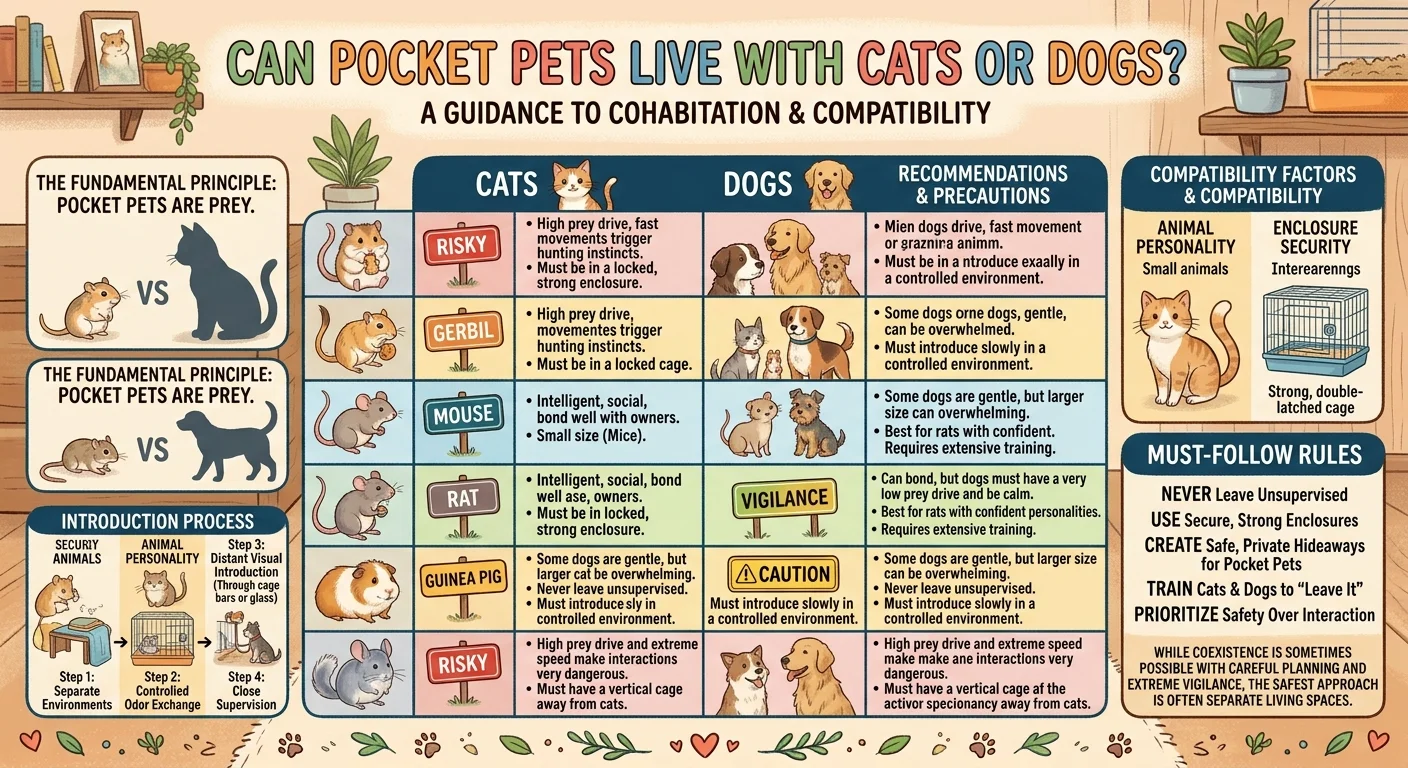
Cats and dogs are predators, while many pocket pets are prey animals.
Even a friendly dog or cat can seriously injure a small mammal.
Keep small pets in secure habitats that prevent access by other household animals, and never assume that an animal is safe simply because the pets appear friendly.
How Long Do Pocket Pets Live?
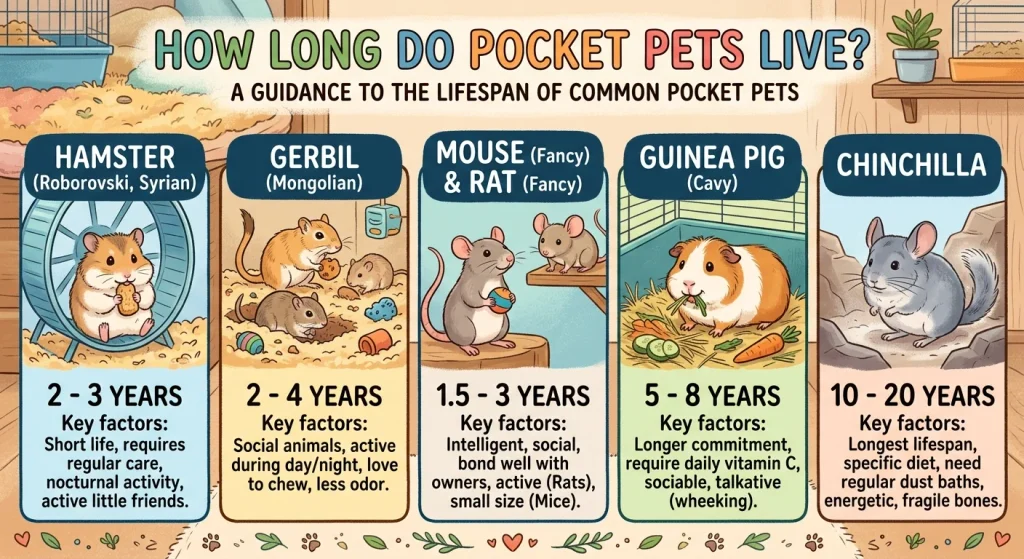
Lifespan is one of the most overlooked considerations when choosing a pet.
Some small mammals may live only a few years, while rabbits and chinchillas can require a commitment lasting a decade or longer.
Before adoption, ask yourself:
Can I still care for this animal five or ten years from now?
Consider future changes such as:
- Moving
- College
- Marriage
- Children
- New jobs
- Travel
- Changes in income
Choosing a pet is a long-term responsibility.
Where Should You Get a Pocket Pet?
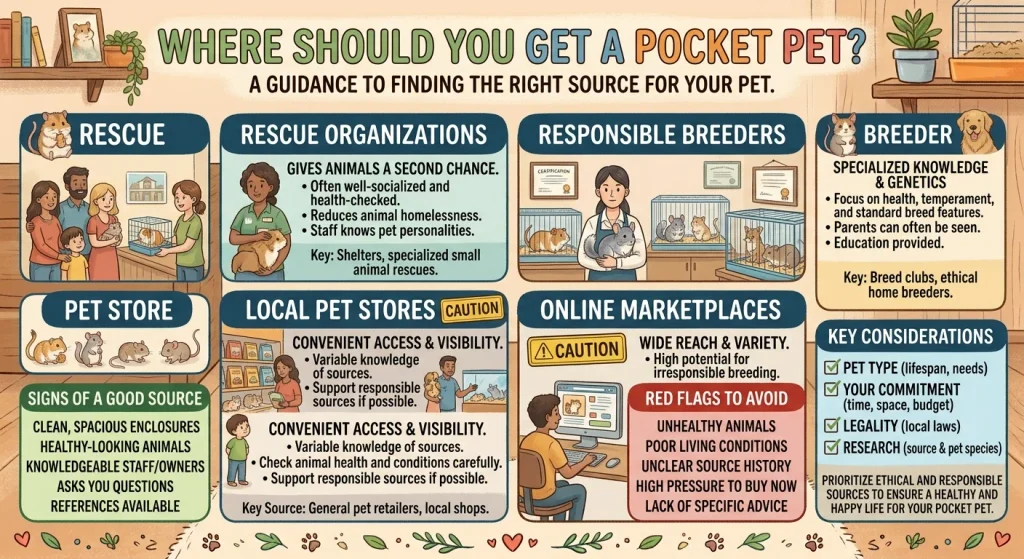
Consider adoption or rescue before purchasing from a seller.
Animal rescues can help you understand the animal’s personality, health history and care requirements.
If you purchase from a breeder or other source, research them carefully and avoid sellers who cannot answer basic questions about health, housing, socialization and the animal’s background.
Never buy an animal simply because it is available immediately.
Pocket Pet Adoption Checklist
Before bringing your new pet home, make sure you have:
- Researched the species
- Checked local ownership rules
- Confirmed the pet’s social requirements
- Prepared the correct habitat
- Purchased species-appropriate food
- Prepared bedding/substrate
- Added hides and enrichment
- Purchased a secure carrier
- Located a veterinarian experienced with the species
- Created an emergency-care budget
- Made a plan for vacations and emergencies
- Confirmed that everyone in the household agrees to the commitment
Pocket Pets: What Beginners Often Get Wrong
Buying the smallest cage
Small body size does not mean the animal needs a tiny enclosure.
Choosing by appearance
A cute animal may have care requirements that do not fit your lifestyle.
Ignoring social needs
Some species need compatible companions.
Assuming all small pets are cheap
Food, bedding, equipment and veterinary care can cost much more than the animal itself.
Buying before researching
The correct order is:
Research → choose species → prepare habitat → locate vet → bring pet home.
Pocket Pet Decision Guide
Use this quick guide:
Want a pet that is mostly independent?
Consider a hamster, depending on the species and your lifestyle.
Want a social daytime companion?
Consider guinea pigs.
Want an intelligent pet you can train?
Consider rats.
Want a pet that enjoys digging and exploring?
Consider gerbils.
Want a long-term small-mammal commitment?
Consider chinchillas or rabbits, but research their substantially different care needs.
Want an unusual exotic pet?
Research hedgehogs, degus or other species carefully before committing.
Pocket Pets vs. Dogs and Cats
Pocket pets can require less living space than dogs and may have lower food costs, but that does not make them automatically easier.
Dogs often require outdoor exercise and extensive human interaction.
Cats typically need less direct exercise from their owners but still require enrichment, veterinary care and long-term commitment.
Pocket pets shift more of the responsibility toward habitat design, species-specific nutrition, environmental enrichment and careful handling.
The best pet is therefore not necessarily the smallest one.
It is the animal whose needs you can consistently meet.
FAQs
What is the best pocket pet?
There is no universal best pocket pet. Hamsters, guinea pigs, rats, gerbils, rabbits and other small mammals suit different lifestyles. The best choice depends on your budget, space, schedule, desired interaction and ability to meet the animal’s care requirements.
What is the cheapest pocket pet?
Hamsters and gerbils can be relatively affordable compared with larger small mammals, but the total cost includes habitat, food, bedding and veterinary care. Compare ownership costs rather than purchase price alone.
What is the easiest pocket pet to take care of?
Some hamsters and gerbils can be easier for certain owners, but every species has specific care requirements. “Easy” should never mean ignoring habitat size, nutrition, enrichment or veterinary care.
What pocket pets are good for beginners?
Hamsters, guinea pigs and rats can all be suitable for beginners when the owner understands their species-specific needs. The right choice depends on the type of interaction and care the owner wants.
What pocket pets are good for children?
Guinea pigs can be a good family option because they can be active during the day and often tolerate gentle handling. However, adults should remain responsible for their care.
Which pocket pets can live alone?
Some hamsters are naturally solitary, while many other small mammals have important social needs. Always check the specific species before deciding whether one animal can live alone.
Which pocket pets need to live in pairs?
Guinea pigs, rats, gerbils and degus are among the small mammals with significant social needs. The correct pairing or grouping depends on species, sex and compatibility.
Are pocket pets expensive?
They can be inexpensive to acquire but surprisingly expensive to maintain. Habitat, food, bedding and veterinary costs can exceed the original purchase or adoption fee.
Are pocket pets good apartment pets?
Some are well suited to apartment living, but enclosure size, noise, odor, exercise and landlord rules must be considered before choosing an animal.
Do pocket pets need a veterinarian?
Yes. Small mammals can have specialized healthcare needs. Ideally, locate a veterinarian who is experienced with the species before bringing the animal home.
Do pocket pets smell?
Odor depends heavily on species, enclosure design, ventilation, bedding, cleaning and waste management. Good husbandry can significantly reduce unpleasant smells.
Can pocket pets be affectionate?
Yes. Rats and guinea pigs can become very interactive with their owners, while other species may prefer observation or limited handling. Personality varies between individual animals.
How long do pocket pets live?
It varies greatly. Some hamsters and rats may live only a few years, while rabbits and chinchillas can live a decade or longer.
Should I adopt or buy a pocket pet?
Adoption is worth considering because many small animals need new homes. If purchasing, research the seller carefully and make sure the animal’s health and welfare are being prioritized.
What’s the easiest small pet to take care of?
There is no single easiest small pet for everyone. Hamsters can be one of the more manageable choices for people who want a relatively independent small companion, while guinea pigs and rats require more social interaction and daily involvement.
Hamsters are generally solitary and can suit owners with limited space, but they are primarily active in the evening and at night. Their enclosure still needs appropriate space, bedding, enrichment, food, water, and veterinary care.
If your definition of “easy” means easy to handle and interact with, a well-socialized rat or guinea pig may be a better match than a hamster.
The easiest small pet is therefore the one whose daily routine, habitat, social needs, noise level, and care requirements fit your lifestyle.
Best overall for simpler care: Hamster
Best for interaction: Rat
Best for daytime companionship: Guinea pig
Even beginner-friendly pets are not maintenance-free. Small pets need species-appropriate housing, nutrition, enrichment, cleaning, and access to veterinary care.
What are the best small pets for cuddling?
If cuddling and gentle handling are your top priorities, guinea pigs and rats are among the strongest choices.
Guinea pigs are social and can become comfortable with calm, consistent handling. Rats are highly interactive, intelligent, and often develop strong bonds with their owners.
Rabbits can also be affectionate, but many rabbits prefer being petted while sitting on the floor rather than being picked up.
Hamsters can be rewarding companions, but they are usually less suited to frequent cuddling. They are often active at night and may become stressed if awakened or handled while sleeping.
Best small pets for cuddling:
- Guinea pigs — gentle, social, and suitable for daytime interaction.
- Pet rats — intelligent, interactive, and highly trainable.
- Rabbits — affectionate but often prefer floor-level interaction.
- Hamsters — enjoyable to handle when comfortable, but usually more independent.
The individual animal matters too. A pet’s personality and previous socialization can make a major difference. Current small-pet comparisons similarly place guinea pigs and rats high for interaction and bonding.
What are the best small pets for anxiety?
A pet should not be chosen as a treatment for anxiety, but some small pets can provide companionship, routine, and opportunities for gentle interaction.
If you want a small pet that you can regularly interact with, guinea pigs and rats may be worth considering. Both are social animals and can become comfortable with their owners when handled appropriately.
If you prefer watching an animal rather than holding it, a hamster or gerbil may be a better lifestyle match.
Consider these factors before choosing:
- How much interaction you want each day
- Whether you want a pet you can handle
- Noise level
- Cleaning requirements
- Social companionship needs
- Whether the animal is active during your waking hours
- Veterinary availability
- Your long-term budget
The goal should be to choose an animal whose needs you can consistently meet rather than choosing a pet based solely on the idea that it will reduce stress.
What small pets are easy to take care of?
Some small pets can be relatively manageable, but none should be considered “no-care” animals.
Hamsters, gerbils, guinea pigs, rats, and mice can all be suitable for different beginner households when their species-specific needs are understood.
| Small pet | Relative care | Best for | Main challenge |
|---|---|---|---|
| Hamster | Moderate | Solo owners | Night activity and habitat needs |
| Gerbil | Moderate | Observing active behavior | Social needs and digging |
| Guinea pig | Moderate | Families | Space, diet, companionship |
| Rat | Moderate | Interaction and training | Social needs and short lifespan |
| Mouse | Moderate | Observation | Small size and social considerations |
| Rabbit | Higher | Long-term companions | Space, exercise, diet |
| Chinchilla | Higher | Experienced owners | Specialized care and heat sensitivity |
| Ferret | Higher | Highly interactive owners | Exercise, enrichment, and veterinary care |
Veterinary and animal-welfare sources emphasize that small animals still require appropriate housing, nutrition, enrichment, cleaning, and health care.
What is the cleanest house pet?
For small furry pets, hamsters and gerbils can be relatively clean and produce comparatively little odor when their habitats are properly maintained.
Gerbils may produce slightly less smell than hamsters, although odor depends heavily on enclosure design, bedding, ventilation, cleaning, diet, and the individual animal.
A clean pet is not necessarily a pet that needs less care. Regular spot cleaning, appropriate bedding, good ventilation, and proper waste management are still important.
If minimizing odor is your priority, compare:
- Waste production
- Enclosure size
- Ventilation
- Bedding absorbency
- Cleaning frequency
- Number of animals
- Diet
Best small furry choices for low odor: Gerbil and hamster, provided they receive proper husbandry.
What pet can be left alone all day?
No companion animal should be treated as a pet that can simply be ignored all day.
If you work or attend school during the day, a hamster may fit your schedule better than a highly social daytime animal, because hamsters are generally most active in the evening and at night.
However, being alone during the day does not mean being without care. Your hamster still needs fresh water, appropriate food, a clean and secure habitat, enrichment, health monitoring, and regular human care.
Guinea pigs and rats have important social needs, so their companionship requirements should be considered carefully before choosing them.
Best match for a busy daytime schedule: A properly cared-for hamster may be more compatible than a highly social pet that expects daytime interaction.
What are the best small pets for a bedroom?
A bedroom can work for some small pets, but noise and activity schedule are often more important than the animal’s size.
Hamsters can be problematic for light sleepers because they are active at night. Exercise wheels, digging, chewing, and movement can become noticeable when you are trying to sleep. Best Friends Animal Society specifically notes that hamsters’ nighttime activity may make a bedroom a poor location.
Before keeping a small pet in your bedroom, consider:
- Nighttime activity
- Wheel noise
- Bedding and cleaning
- Odor
- Ventilation
- Temperature
- Space for an appropriate enclosure
- Whether you are a light sleeper
Bedroom suitability depends on the individual home, but a quiet, well-maintained enclosure and appropriate placement are essential.
What are the best small pets for beginners?
For many first-time owners, hamsters, guinea pigs, and rats can be reasonable choices when the owner researches their specific requirements.
Choose based on the type of relationship you want:
- Hamster: More independent and generally solitary.
- Guinea pig: Social and suited to daytime interaction.
- Rat: Highly intelligent and interactive.
- Gerbil: Active and entertaining to observe.
Beginners should not choose based only on size or purchase price. Before bringing a pet home, research its enclosure requirements, diet, social needs, lifespan, veterinary care, and expected monthly expenses.
Animal-welfare organizations also recommend considering your home, routine, children, other pets, space, and the specific companionship requirements of each species.
What is the best small pet for a small apartment?
A small apartment does not automatically mean you need the smallest animal.
Hamsters, gerbils, mice, and rats can work in apartment homes when their appropriate habitats, ventilation, enrichment, and noise levels are considered.
However, rabbits and guinea pigs can require substantially more floor space than their body size suggests.
The best apartment pet is therefore the one whose habitat, noise, odor, exercise, social needs, and daily care fit the available space.
What small pets are quiet?
If quietness is important, consider the animal’s natural activity schedule and the sounds produced by its enclosure.
Hamsters can be relatively quiet during the day but may become active at night. Wheels and digging can create noise.
Gerbils can also be active, especially when digging and exploring.
Rats and guinea pigs can make a variety of vocalizations and enclosure sounds.
For a bedroom or noise-sensitive household, do not judge quietness only by the animal’s size. Consider the complete habitat and when the pet is most active.
What small pets can live alone?
Some small pets are naturally solitary, while others have important social needs.
Many hamsters, particularly Syrian hamsters, are generally housed alone. In contrast, guinea pigs, rats, gerbils, and degus have significant social needs and should not automatically be kept alone.
The correct arrangement depends on species, sex, compatibility, and individual circumstances.
Never assume that two animals can simply be placed together because they are the same species. Research the species-specific social requirements first.
What small pets need a companion?
Guinea pigs, rats, gerbils, and degus are examples of small mammals with important social needs.
Companionship can improve welfare when animals are housed in appropriate, compatible groups, but introductions must be handled carefully.
Hamsters are different: many are solitary and may become territorial when housed with another hamster.
Before getting a second pet, research the species, sex, compatibility, enclosure requirements, and introduction process.
Are small pets really low maintenance?
Not necessarily.
Small pets may require less space or less direct human involvement than some dogs, but they still depend completely on their owners for appropriate care.
Their needs can include:
- Species-appropriate housing
- Food and fresh water
- Bedding
- Cleaning
- Exercise
- Enrichment
- Social companionship
- Temperature control
- Grooming where required
- Veterinary care
- Emergency care
Animal welfare organizations specifically warn that being small does not mean an animal requires less care.
What is the best small pet for a child?
For many families, guinea pigs can be a good option for supervised interaction, particularly because they can be active during the day.
However, the adult—not the child—should remain responsible for the animal’s welfare.
Consider the child’s:
- Age
- Ability to handle animals gently
- Attention span
- Understanding of boundaries
- Ability to follow feeding and cleaning routines
Also consider the pet’s lifespan and veterinary costs before bringing it home.
What is the best small pet for someone who works all day?
A hamster may fit a daytime work schedule better because it is generally most active during the evening and night.
However, this does not mean a hamster can be ignored. It still needs daily care and health monitoring.
If you want an animal that is active when you are home after work, a hamster may be a better schedule match than a pet whose main activity occurs during the daytime.
What is the best small pet for cuddling and low maintenance?
There is a trade-off here.
The pets that tend to provide more interaction, such as rats and guinea pigs, also have greater social and daily-care requirements.
A hamster may be easier for an owner seeking a more independent pet, but it generally is not the strongest choice if frequent cuddling is your main goal.
Cuddling: Guinea pig or rat.
Independence: Hamster.
For observation: Gerbil or mouse.
There is no small pet that combines maximum cuddling with zero maintenance.
What is a good small pet for a bedroom if I am a light sleeper?
A hamster may not be the best choice for a light sleeper because it is primarily active at night.
The sound of a wheel, digging, chewing, or moving around the enclosure can disturb sleep.
Before placing any small pet in your bedroom, consider the animal’s activity schedule and the noise produced by its habitat. Best Friends Animal Society specifically recommends thinking carefully before placing a hamster in a bedroom because of its nighttime activity.
Does Donald Trump have a pet?
As of the latest publicly available information I found, Donald Trump does not have a personal pet.
During a May 20, 2025 White House briefing, Press Secretary Karoline Leavitt said that Trump did not have any pets at the time and that there were no pets living at the White House, apart from working Secret Service dogs.
Trump also became notable during his first presidency for not having a presidential pet. Historical records list his 2017–2021 White House administration as having no pets.
This question is not directly related to choosing a pocket pet, so I would place it near the bottom of the FAQ rather than making it a major section of the article.
What is the best small pet overall?
There is no universal winner.
Relatively independent pet, a hamster may be a strong choice.
Social daytime companion, guinea pigs may be a better match.
Intelligence, training, and close interaction, rats are especially appealing.
If you enjoy watching digging and exploratory behavior, gerbils may be a good fit.
The best small pet is ultimately the one whose space, social needs, activity schedule, diet, lifespan, veterinary requirements, and total cost match your lifestyle.
Before choosing, compare the animal’s complete care requirements rather than choosing based on appearance or purchase price alone.
Final Verdict: Which Pocket Pet Should You Choose?
Ultimately, the best pocket pet is not necessarily the cheapest, smallest or cutest animal.
Choose based on care requirements, social needs, lifespan, space, daily schedule and total cost.
For a smaller and more independent companion, a hamster may be worth considering.
Social, daytime-oriented family pet, guinea pigs may be a better match.
For owners who want intelligence, interaction and training, rats can be especially rewarding.
For people willing to take on a longer and more specialized commitment, rabbits and chinchillas may be appropriate—but they require substantially more preparation than many first-time owners expect.
Before bringing any pocket pet home, research the species, prepare the habitat, locate a suitable veterinarian and budget for both routine and unexpected expenses.
A successful pocket-pet relationship starts before you bring the animal home.